

We need to go back about 10 days…..one of the things we did in Cambodia which we wanted to share with you was that we went back to school for a short visit.
It was truly a day of polar opposites. In the morning we visited sites like Angkor Thom which, 1000 or more years ago, had been a rich and civilised city of 100,000 people at a time when London was only a small town (and New Zealand was still 600 or so years away from even being sighted by a white man); and in the afternoon we went to a school so poor that they need daily donations just to keep the children fed. It makes you wonder a little about the ebb and flow of so-called great empires.
The school we went to was in the floating village of Chong Kneas which we visited from Siem Reap by tuk tuk and dirty old diesel boat (complete with a snake on board as an unwanted passenger on the way back!). Tonle Sap is the largest lake in SE Asia with an area of 2700km2 in the dry season which grows to a staggering 16000km2 in the wet, and it has over 170 floating villages dotted around its shores. (When the rainy season comes, the villages literally up anchor and move, as they stay approximately the same distance from shore, even although that shore may move several kilometres “inland”.) Perhaps Chong Kneas is the best known village because it is not only the largest of them all but it is also a tourist trap being so near to Siem Reap. Take it from us though, the tourists haven’t brought any great prosperity to the locals, that’s for sure. The mothers still hang snakes around their toddlers’ necks in the hope you’ll take a photo, for which they expect US$1.
And by the way, it’s not really a village in size either – we were told that the permanent population of Chong Kneas is around 6000 people, all living on the water. A number of them work in Siem Reap and at the temples but the majority subsist solely on fishing from the lake. Their homes are basically houseboats in varying degrees of (dis)repair, bunched together in small groups attached to a bamboo structure in the centre which is essentially their anchor. In addition to the hundreds of “houses” there are other structures, most larger in size, which house things like shops, a gymnasium (all four sides are deck to roof netting so the ball doesn’t go overboard – there were some boys playing basketball as we cruised by), a drinking water plant, a battery charging station (drop off your low battery in the morning because power isn’t needed during the day, and pick it up fully charged at night), a Catholic Church, a fish farm, a market garden and so on….and a school.
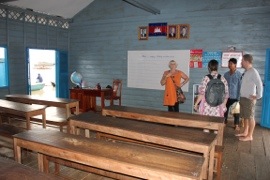
We think there are actually two schools possibly one of them being alongside the gym, but the one we visited is run by a Vietnamese charity and consists of two boats tied together because it outgrew the original ‘one boat’ affair. It is used to teach younger children from the village, especially the many orphans who not only are educated there, but live there as well. This is where the greatest need arises – this is a very basic school indeed, as you’ll see from the photo of the classroom, and it is in a country where great poverty is sadly just a way of life. All the kids desperately want to learn, but for some, even just a mattress to sleep on and a bowl of rice for dinner are things for which they are truly grateful.
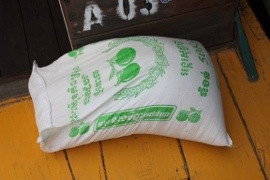
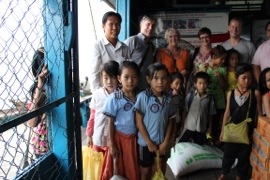
So, in a practised move which was slick but when all is said and done was such a simple and relatively inexpensive thing to do, we were taken first to a floating market shop (also part of the village) where the four of us (us two, plus Jeannie and Jonathan) purchased a 50kg bag of rice for US$80, and then we were taken to the school to donate it. It was just so sad to think that such manoeuvres are necessary, but if that’s what it takes, then we were happy to do our bit. Yes, the Cambodian government should be taking care of such things but from our admittedly casual observation over just a few days in the country they clearly have a huge number of things to deal with; and yes every dollar of foreign aid should be reaching those who actually need it but all too often this doesn’t happen does it?
And we don’t want to sound overly cynical about the fact we did the school via the shop route…that was a decision we had some control over. Our tuk tuk driver had suggested that we would see a bit more behind the scenes by not taking the ‘normal’ tourist boat option which involves a much more modern vessel (in fact, it’s basically a floating restaurant and bar). That might sound good, but it pretty much just gives you the chance to look at the village from a safe distance and presumably make sympathetic noises about the conditions the villagers live in.
Our choice to go the back door route not only enabled us to share the boat with a snake, but also with the boat owner’s young son who scored a can of Coke from us and more importantly with our young unpaid guide. His name was a mystery to us, but he was a really neat guy aged in his early 20s who goes out on the boats to tell tourists about the village where he grew up, and learns more English in the process. He wants to study more, having got his start in education at the floating village school, but in the meantime, he’s prepared to guide tourists solely for the tips. Good on him, and what a pleasure to meet a young man with all the ambition in the world despite the odds being stacked against him.
So by helping him out a little and by buying a bag of rice which will last the school about a month we believe we helped in a very small way and we hope that others back home might feel inclined to do their bit as well. A lot of people following this blog are involved with Lions, so who knows, maybe something might happen where a donation through LCIF might be directed to the children at Truong Hoc School, Chong Kneas, Cambodia?? If anyone else would like suggestions on how they might help, just let us know. Incidentally, if the children have money they can pay 200-300 Cambodian Riel per day for their schooling, otherwise it is free. 300 Riel is 9 NZ cents!
Footnote: while we’re talking about aspects of life near poverty level, we should also tell you about the children we met on our last night in Siem Reap. We’d just enjoyed another extremely tasty and embarrassingly cheap meal (not totally perfect though – Andrew’s snake was excellent, but one of the pieces of crocodile was just way too tough and couldn’t be chewed no matter what!) and were heading for the tuk tuk rank when a couple of young girls aged probably about 10, both with a young sibling on their hip, approached us each saying “I don’t want money but can you buy us baby formula for our little sister/brother?”
Next thing we knew, we were in a nearby shop buying a couple of tins of formula – they knew exactly what they wanted and it’s hard to see what else it could have been used for except the intended purpose – and we sent them away apparently happy. Again, it’s just very sad that such things happen, but they do, and maybe we made a difference that night as well…who knows?
 The Moffats on Tour Blog
Amazing!……:). Such a difference is always profound. Much love awesome people xx Love Doris and Cleetus