Un día en Madrid…

Sunday 16 September…..Madrid, Spain

Well, it’s been over a fortnight now since the last blog and we’ve done and seen a lot of interesting things since (remind us to tell you in due course about apes on a rock, cork off a tree, flamingoes in a lake and the difference between green and black olives), but we wanted to tell you about the day we spent in Madrid recently.

Our camp was about 30km to the west of the city but there was a bus stop right at the gate, and after a longer than expected wait because the camp’s bus timetable was, naturally, not the same as the bus company’s timetable, we managed to catch the necessary two buses into the Pio Principe bus station in Madrid. Then, after the usual orientation issues which arise when you emerge into daylight from an underground bus or metro station and have no idea at first where the “top of the map” is, we headed off walking towards the older part of the city. We have really enjoyed the old, historical parts of every European town we’ve been to – there is just so much more character and life to those parts than there is in the more modern developments, no matter how spectacular the “new” architecture is.

By the way, a little aside here: we found out which direction to walk from a friendly Spanish policeman who not only spoke pretty good English, but was very tolerant as he answered questions from several tourists in a row. This was our first direct encounter with the Spanish police – we’ve now had three, and each one has been excellent as they’ve all been extremely pleasant and helpful. We even got a police escort through the town of Ronda in Andalusia when the cop we asked for parking advice decided it would be easier to get us to follow him rather than give us the directions! Just a pity he didn’t see the need to turn his lights and siren on as well…that would have been impressive! All in all (so far) top marks to the Spanish police…..a far cry from the gun-toting, ticket-issuing, campervan-impounding lot we’d been told to expect that’s for sure.

Anyway, back to our day….a quick stop for coffee, then on with our walk. We’d read about a couple of suggested walking tours but decided to create our own. First stop, Plaza del Carmen (you should always visit places named after family members, and also that was where we had to collect our pre-ordered bullfight tickets), then off to Puerto del Sol. This is one of the main squares and contains Spain’s “Kilometre Zero” from which point all official distances in the country are measured. The square also contains any number of street artists….living statues (best ones that day: the twosome of a 19th century African explorer taking a photo of a native woman; the man with no head; and the absolutely outstanding guy who was playing the part of a baby in a pram), buskers, a man who REALLY had no arms but who held his coin collecting cup in his mouth and still managed to talk at the same time, plus assorted beggars and other various forms of con artist.

Next main stop, after a wander through Plaza Mayor, was at the Rastro Markets in the south of the old city. This is an overcrowded, rambling and chaotic Sunday marketplace, with hundreds and hundreds of stalls, thousands of shoppers where you can buy almost anything you can possibly imagine: clothing, shoes, souvenirs, pots, pans, pocket watches (not working, most without hands in fact), antiques, food, tools, CDs, sunglasses….the list is almost endless! It is a bit too much really! Jostling and shopping completed, we needed food so headed to a quieter part of the city for lunch – warning: don’t order “Pie of the Day” in Madrid without the precaution of finding out what it is first…..otherwise you might get the “cold tuna” special, and it will not really be very nice!

Then, as one of us had sufficiently recovered from the morning’s shopping, it was time to try some more, this time in what appears to be Spain and Portugal’s largest department store: El Cortes Inglés. Quite bizarrely, that name translates directly as “The English Parliament” but I have no idea of the history here – although the store certainly appears to be a lot more organised than any Parliament that I know of. The only thing of interest that I remember from the shop was the imitation rugby jerseys on special, with an Australian flag and a logo proclaiming “Australian Rugby – AUCKLAND”.

Getting a bit hungry again, so we called at St Gines Chocolate Shop which sells, according to the advertising, the world’s best churros which, for the uninitiated, are long deep fried pastries. We quite like churros, but are more used to the ones just dipped in cinnamon and sugar…..these ones however, came with a cup each of rich dark hot melted chocolate. Mmmmmmmmm! Good for you of course, absolutely no calories at all. And we’d done a lot of walking that day, so it was more a essential snack than a luxury!

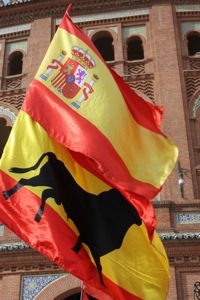
Then it was off to Las Ventas, the Madrid bull ring for what I suppose was the highlight of the day. Certainly it was the most memorable experience of the day – highlight probably isn’t quite the right word to use. Our summation afterwards is that it was an experience that we can now say we’ve had, but it is 99.9999% likely that we will never feel the need to repeat it. A bullfight is different, that’s for sure, and is it part of the way of life in many parts of Spain, but is it a pleasant experience? No, not really…..and that’s just from a newly initiated spectator’s point of view. The perspective from the bull’s standpoint is even less positive of course. Interestingly, we’ve since discovered that the Spanish are not universally in support of bullfighting – it’s banned completely in some parts including Catalonia, and it’s only rarely practiced in many others. It’s really only in the centre of the country around Madrid, and in Andalusia in the South, where it is reasonably popular.

(Another interesting point – in Portugal, the bull doesn’t die….in Spain however, he lives in only the rarest of cases when the matador feels the bull has been such an honourable opponent and has fought so bravely that his life is worthy enough to be spared. But, given that this would by definition mean the matador conceding that he, the human, had been outsmarted by a mere animal which would be a considerable blow to the obviously huge ego the matador brings to the event, it is a VERY rare event indeed.)

I think the pictures attached will tell enough of the story, but here’s a summary of a Spanish bullfight – there are six fights, two bulls each for three matadors. Each fight is divided into three parts or tercios, after a ceremonial parade of the (human) participants, being the matador and his entourage consisting of 2 picadores on horseback, 3 banderillas and a sword page. Each third is announced by a bugle blast:
:: the “lancing third” where the matador and his banderillas work out the bull’s strengths and weaknesses, traits and quirks, by testing him with manoeuvres using the gold and magenta capes. We noticed that the banderillas spent most of their time ducking for cover behind the heavy wooden barricades around the ring – they only appear to be brave when the bull ISN’T targeting them personally! Towards the end of this third, the picadores enter the ring on their horses which wear very heavy protective coverings because the bull’s natural instinct is to gore the weaker animal and try to disembowel it. (Until the 1930s, the horse was not protected at all, so consequently the horse death rate at Spanish bullfights was always higher than that of the bulls!). The picadores job is to get into position near the bull and lance it in the back to weaken it and start it losing blood.
:: the “third of banderillas” where the matador and the banderillas anger and agitate the bull further, and seriously get the blood flowing, by each attempting to plunge two sharp barbed sticks into the bull’s back.
:: the tercio de muerte (the “third of death”) which is just the matador alone against the bull – the former armed only with his muleta (red cape) and an estoque simulado (a light sword usually wooden or aluminium). A number of cape flourishes take place, the closer to the bull the better, with the intention being to wear the already weakened bull down even further, and eventually leading to the matador changing to his estoque de verdad (“real sword”) and, after facing the bull head on, plunging the sword between the bull’s shoulder blades and through its heart.

There’s a bit more bloodthirsty stuff after that but the end result is an ignominious exit for the bull, dragged out by one horn behind a couple of horses, a raking up of the bloodiest sand by the bull ring staff, and a strutting egotistical lap of honour for the matador who “earns” the cheers and applause of the crowd. And if he’s been especially good in his effort, as admittedly one of ours was with a great deal of showmanship in his performance, the crowd all wave white hankies and ask for the matador to be awarded one of the bull’s ears!

The rest of the evening had the potential to be a little subdued after that, but we decided to put it all down to experience, and took the Metro back to the Teatro Real district for dinner at a very nice restaurant (I had a steak, just to prove I was over the bullfight!), then the return two bus trips back to a well earned rest in our home away from home.

All in all, a very interesting and worthwhile day in the Spanish capital – you’ll find a few photos if you click here
20120929-133253.jpg

Passions of France

No, not “passion in France” – sorry to disappoint you – but a blog to tell you all about a very special kind of place where we’ve been staying as we travel around France in our camper van. When we picked the van up in the UK, we also collected a number of European campsite guidebooks to take with us. We’ve used them all – either to find a fully serviced camping ground when we need all facilities like Wi-Fi, washing machines and dryers etc., or to find an “aire” which are the free places like motorway laybys, service stations, truck stops, rest areas etc. But the best book of them all and the one we’ve used on a number of occasions recently, is the one entitled “France Passion 2012”. This has opened up some wonderful doors to us – doors that could be up to 500 years old as we’ve discovered – and doors that lead to some extremely interesting experiences.

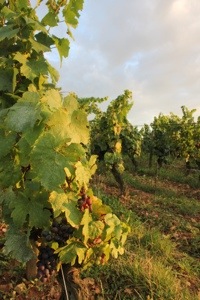
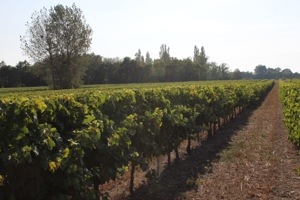
What is this all about? Passions are locations all over France….1700 of them in fact….where self sufficient camper vans are welcomed for an overnight stay. Each location offers a friendly invitation to motorhome owners to come and stay, whilst the property owners carry on their normal day to day activities. So, you park your van on the property, usually ‘out the back’ somewhere – tonight for example we are under the willow trees which are less than 20m from sixteen hectares of Merlot, Cabernet Franc, and (a new one to us) Ugni-Blanc Grapes – and then learn about what the property is all about, what the people do, what they produce and so on. The hosts are farmers or wine growers primarily, but between them all they cover every aspect of French rural life. And of course there’s the opportunity to sample and buy some of their product, but there’s absolutely no obligation to do so, so therefore no need to sneak away before dawn the next day to avoid the shop! In most cases there are no services offered which is fair enough when there’s no payment expected, but some will have rubbish disposal, water, occasionally electrical hook-up, and maybe even toilets, especially if the property is also a commercial premises like a vineyard offering tastings and meals.

We have been hosted now on seven occasions, from the Pas-de-Calais region in the north on our very first night in Europe back in mid-June, to a vineyard in the Var region of the South. Here’s a brief idea of the variety of places we’ve enjoyed….
:: a vegetable grower (légumes de saison) on the very edge of the village of Locon, near Béthune in Pas-de-Calais. This was our first place, and where we first encountered the very European concept of farms being right on the edge of urban areas….in this case, as you viewed it from the road the 50ha of vegetables were to the right of, and behind, the owners’ house, whilst to the left of the house was the village hairdresser’s salon and then 150m of houses leading up to the church and the village square! And beside the implement sheds out the back was where we parked up, and had a very peaceful meal and overnight sleep in the tranquil French countryside. Next morning, we stocked up on freshly dug new potatoes, beans, garlic and tomatoes (at extremely cheap prices too!) before we headed off.
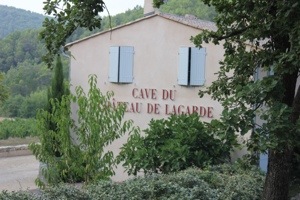
:: the Cave du Chateau de Lagarde, a rosé wine and olive oil producer near Fignieres in Var not far from Cannes. This one was the carparking area of a wine tasting boutique, in a new building made to look old. Corinne, the hostess, was a lovely lady who was very enthusiastic about the wines she produced, and who not only allowed us to taste them all, but gave us the remainder of the bottle of rosé which we’d just sampled from! Next day before we left, of course, we went back into the shop, and came away with a very tasty jar of pear jam, a bottle of olive oil which will keep us going for months, and another bottle of the rosé!
:: two days later, we changed grape varieties and parked alongside the sheds on a Beaujolais vineyard at Lachassagne, north of Lyon in the Rhône region. We not only met the owner in the very well stocked shop the next morning, but also met her dog Saturn who showed us what a clever boy he was with his tricks. (The owner, finding out we were from Nouvelle Zealande, rang her sister in law from Avignon and got us to talk to her….a Kiwi who has lived in France for 22 years and still has her NZ accent). Possibly bemused by the dog’s antics, and definitely intoxicated by the sheer notion of having spent the night in a Beaujolais vineyard (this time right smack bang beside the first row of vines) we managed to buy a couple of bottles, plus some locally produced goat’s cheese. And here’s a fact you may not know – Beaujolais isn’t just a red wine…..they have a white variety and a rosé as well. All you real wine connoisseurs out there will of course know that, or at least say you did, but we will be honest and admit that we didn’t know so once again, this trip has expanded our knowledge base! And the taste of both the wine and the cheese? Très magnifique!!
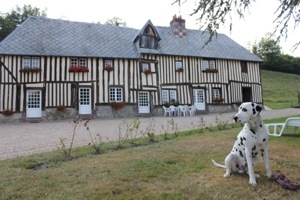
:: change of drinks now, with two properties in the Calvados region of Normandy both located on 10 or so hectares of orchards growing apples and pears, and both with the owners living in homes first built in the 1600s! (And one, Le Lieu Chéri near Lisieux, was complete with a “wine dog” as well, a Dalmatian youngster named, we think, Garayon). In both places they use a process that is hundreds of years old to turn the fruit into juice, cider, Pommeau, or a cognac-like drink named after the region, Calvados. The process includes steps like letting the apples fall to the ground and picking them up from there rather than from the branches, and then juicing the entire fruit all bar one part. The skins, stalks, cores – everything goes in the mix….all except the pips which are definitely excluded as they are too bitter. We tasted all the resulting varieties, and they’re all great, but as there are limits to both our budget, and also the the carrying capacity of the camper, from the first place we only bought some pear cider and a bottle of Pommeau (an aperitif made from 3/4 apple juice, 1/4 Calvados and then left in an oak barrel for 3-4 years without any fermentation….as opposed to the Calvados itself which is fermented juice that has been aged in oak barrels for up to 30 years) and from the second a jar of Confite de Cidre au Calvados, plus a small bag of caramels which taste kind of like Jersey Caramels and are made from their fruit jam and milk. Come to think of it the Channel Islands including Jersey are not far off the coast of Normandy, so there’s probably every good reason why caramels from Normandy should taste like those from Jersey!
:: the next place was a real gem – owned by an artist originally from England named Diane who has set up a studio in a tiny village named Leimburel in the centre of the Finistère region of Brittany. We intended to stay the usual one night but had such a great time, and Diane and her friend Yvon (and the dogs Islay, Ruby and Tiki) were such wonderful hosts, that we stayed two nights and have now made friends for life. Purchases here weren’t quite so important – it was so much more about the friendship made, and the instant rapport that we found there – but we did buy some very tasty garden vegetables (courgettes, runner beans, tomatoes and the best strawberries in France!) plus a small watercolour of some pigeons. The painting is significant because everywhere we have been there are always pigeons cooing, so much so that we’ve decided they are actually our guardian angels in disguise, and therefore to find them in a watercolour of Diane’s was just a purchase waiting for us! Our parking spot here was on the grass near the studio, alongside a large paddock of clover which was where Diane’s bees were as busy as…..um, bees. And another little note about this place – the village of Leimburel is a delightful place which used to have 110 inhabitants living in 25 houses, but with the gradual depopulation of rural France as people move to, and over-populate, the cities, Diane is now one of only three people – total – left in Leimburel. It is a crying shame and if it wasn’t for the ridiculous tax and property laws in France, we’d just about be tempted to buy one of the old houses and live there ourselves! If only!!
:: and the property we are in now which produces Pineau des Charentes and 5, 10 and 20+ year old Cognac! (yes, back to the booze!). This one is near Asnierès-la-Giroud north of Bordeaux, the house is only 150 years old, and they make very nice products from the 30ha of grapes which are just about to be harvested by a huge machine which we were proudly shown, after our little pre-dinner tasting session. There’s a similarity to the Calvados process – just as Pommeau is apple juice and Calvados, Pineau is grape juice and Cognac….and Cognac itself of course is the fermented, distilled end result of grape juice.

We have seen some wonderful, off the beaten track sights and places; have been hosted by some lovely people; we have tasted and sampled some very tasty food and drink; we have learned so much about how things are produced; and in the process have really experienced the best of France. Forget Paris! If you come to France and, oh yes, if you’ve got a camper van, then try the France Passion system – you will absolutely love it!

We’re off to Spain and Portugal now (via a cheese place down near Bayonne), but we’ll be back in France again in a few weeks, and then again in November – who knows what new experiences we might be able to add to the list! Watch this space….

20120910-002030.jpg

20120910-140542.jpg

20120910-140615.jpg

20120910-140625.jpg

20120910-140637.jpg

20120910-140718.jpg

20120910-140727.jpg

20120910-140735.jpg

Travelling with Patricia

Hi, it’s Pauline here. This blog is mostly aimed at the friends and family of my sister Patricia (or, after a week in Paris…..Pa-tree-zee-ah as she now thinks it should be pronounced). Of course, you’re all welcome to read about her adventures with us – we just thought that now that Patricia has gone home, we should put our version of events on line in our own defence. So, here comes a bit of a travelogue, recounting some of the events of the past four weeks since we knocked on the door of her Montmartre hotel room door in Paris where she’d had a few days on her own first, and took her on a tour of Europe (well, some of it anyway!). There’s a few pictures of “Travels with Patricia” attached as well…..click here

We started with a return to the first camp we’d stayed in back in mid-June, in the Somme area of northern France after a visit to a supermarket to restock the van, and a quick trip back to a couple of the war memorials we’d seen earlier but wanted to share with our new tenant. After dinner that night, the first live attempt to make up the second bed in the van….and very successful we were too. So successful unfortunately, that Patricia obviously decided that she couldn’t do any better than Andrew and I at it, so left us the job every night for the next 4 weeks! Katrina and Bernard, you’ll be pleased to know though that the bed making and unmaking is a breeze and the bed itself is reportedly very comfortable.

Our next stop was a quick trip back to Bruges which we’d thoroughly enjoyed the first time and felt sure Patricia would also really love the old medieval buildings, the town square, the canals and the boat trip. We weren’t disappointed as she did appreciate all of that – what we hadn’t counted on was the liking she took to the local beers. Admittedly it was a very hot day, but really!! Eventually though, we prised her away from the Beer Wall (a bar which supposedly sells every one of the 1300+ beers brewed in Belgium) and headed for Bruxelles. The plan there, or in nearby Leuven, was to catch up with another of our Clemenger cousins but sadly that didn’t happen due to some illness on their part although we hope to get back to Belgium later in the trip to see Emma and her family. Instead, we had a couple of quiet days near Bruxelles and then a very nice visit to Leuven for Sunday lunch and a walk around the very old cobblestoned streets near the cathedral. It looked a lovely old town, and Patricia really appreciated the chance to see where some of her ancestors had originated from.

We then spent a night in country #3 – Luxembourg – before heading on to Germany and a couple of nights in a camp on the banks of the Neckar River a few kilometres from Heidelberg. On the day in the city, we purchased Heidelberg Cards and were tourists for the day – eating apple strudel, visiting the very old Heidelberg Schloss (and incidentally as part of that, the unlikely but extremely interesting Museum of German Pharmaceutical History!), walking across the Old Bridge, going up to the castle on a funicular railway and then walking down, and then chancing upon an organ recital in an old Church below the castle which was really good. All in all, a good visit to a very nice town, and a place which Patricia really enjoyed.

The next day took us in the morning to the Sinsheim Aviation and Transport Museum which we all enjoyed (highlights maybe being the Air France Concorde and the Russian Tupolev-144 aircraft on display that you could go into) and then in the afternoon on a three country sprint from Germany into Switzerland where we couldn’t find a camping spot and then into Austria where we could, at Bregenz. We kept the run of countries up the next day by going back into Switzerland briefly (don’t tell the authorities though, cos we didn’t buy a windscreen ‘vignette’ to allow us onto the autobahn), quickly through Liechtenstein where we had lunch and got a stamp in our passports, then back into Austria, before crossing the Ehrwald Pass back into Germany to visit Neuschwanstein Castle before calling it a day. All in all, we travelled 370km that day when, had we just gone from Bregenz to Neuschwanstein direct, the trip would only have been 103km!

You know some of the story of the next few days, when we visited Oberammergau – went to a German play and climbed a German mountain – and then spent one more night in Austria where we visited Salzburg and enjoyed a full range of music from Mozart to Rodgers & Hammerstein. We then headed south to Italy and had some great times showing Patricia Venice, San Marino (that was European country #9 for her), Tuscany (the countryside in general, Florence in particular), and then Rome. In Rome, the van started to fall apart and so, coincidentally, did Patricia! Well, that’s a slight exaggeration but she did insist on not wearing a hat on our big sightseeing day and the combination of a lot of walking, seats on the open top deck of the “Hop On, Hop Off” bus, and a temperature in the high 30s all combined to take a bit of a toll! However, she survived (as did we) and could add places like St Peter’s, the Vatican Museums and Sistine Chapel, the Trevi Fountain and the Colosseum to her list of touristy tick-offs.

The problems with the van which couldn’t be fixed locally because most of Italy closes for August and also a sense that we were running a bit short on time after being in Bavaria and Austria for longer than we’d planned, meant that we put our nose down and tail up and got back to France as quickly as possible. That then gave us Patricia’s last full week to spend enjoying France – and we did just that!

We made the most of being in one of our favourite parts of the world – the South of France – and made sure Patricia got to see places like Monaco, Nice, Grasse, Apt and Gourdes. We stayed in a couple of camps, one near Nice and the other right at the top of the hill above Gourdes which many of you will know is one of the most picturesque (and most photographed) villages in France. In between those spots we had a night in a “France Passion” which is one of a series of free camping spots in rural France and which I think will be the subject of Andrew’s next blog post – this one was on the property of an olive oil and wine producer at Fignieres in Provence.

After Gourdes we headed north on the Autoroute to Lyon and encountered the bouchon which we learned means traffic jam in French slang. This involved nose to tail traffic in all lanes, both ways, for many many kilometres which held us up for hours and completely defeated the purpose of paying the toll and using the supposedly faster route that day! The bouchon is caused by a unique French summertime custom – all rental holiday homes in France, of which there are tens of thousands, are rented by the week, from 4pm Saturday to 10am the following Saturday during the peak season. Consequently, everyone using such accommodation is either travelling to or from on Saturday afternoon….and we got well and truly caught in the ensuing chaos! Anyway, we eventually reached our destination and spent a night in another “Passion” vineyard (this one in Beaujolais country) which was a great experience – the next day we moved further north via more delightfully picturesque French countryside to a camp on the banks of the Loire River at St Saur.

After that, all we had left to show Patricia was a bit more of Paris so we spent a day at Paris Disneyland and a day and a half on the tourist trail in the city, adding the Tuileries, l’Opera, the Eiffel Tower, Notre-Dame, the Champs Élysées etc etc to the list. We also found time for some nice dining including a return visit to a place we visited in 2009 – Le Procope which is the oldest restaurant in Paris and where Napoleon used to eat!

Oh, speaking of restaurants, we met the owner of a creperie in Montmartre…..but that’s a story that Pa-tree-zee-ah will have to tell you herself if she chooses to. What goes on tour, stays on tour!!