Something that the South of France has in abundance, apart from olives, grapes, lavender and film stars, is bridges. Yes, bridges! We won’t list them all, but here’s a few notes about the four rather special ones we visited along with Katrina recently…..
Tuesday – Pont Julien
This was one we’d visited with Lawren back in 1998 but a month or so ago when we were in this area with Patricia, we couldn’t find it! However, this latest time we located it straight away. The Pont Julien is near Lacoste in the part of Provence made famous by Peter Mayle in his books, and it’s been there for over 2000 years. In 1998 we drove over it, in a car obviously, but following in the wheel tracks of the Romans who’d built it in 3 BC to use it in their chariots. It turns out now though that the local authorities decided in 2005 to build a new bridge alongside in order to preserve the old one, so our plan to drive a camping car over a Roman bridge was thwarted! We walked over it instead – but it’s quite fantastic to think that this was a bridge that was in daily road use for 2008 years…..one of those things that New Zealanders find a little hard to comprehend at times!
Wednesday – Pont d’Avignon
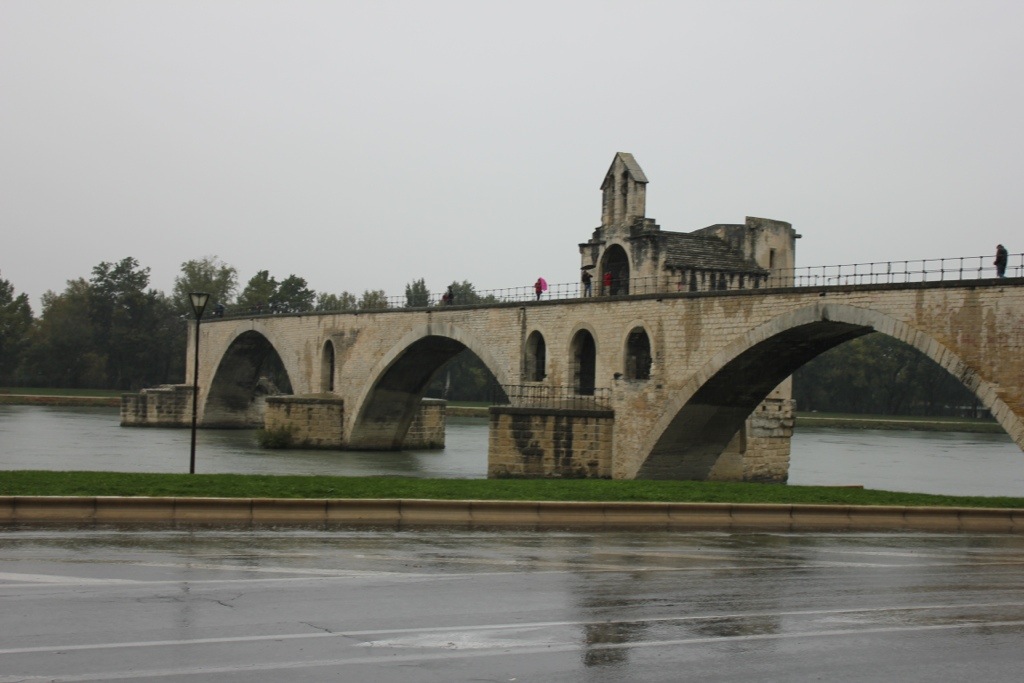
Funnily enough, despite the fame generated through the well known song, this is not the real name of this medieval bridge – it is actually officially known as Pont St Bénezet, named after the local shepherd boy (later canonised) who was told by an angel, according to the legend, to build the original bridge. And while we’re dispelling myths, the song may well mention dancing on the bridge as in “sur le Pont d’Avignon”, but it was originally “sous le Pont” meaning under, because the dances were traditionally held on an island in the middle of the Rhone where the bridge passed over.
Anyway, we certainly didn’t dance on or under or even anywhere near this bridge, because it was absolutely pouring with rain and blowing a gale, so even to walk out on it was a pretty impressive effort. It’s only 4 spans long these days so the walk wasn’t that far…..not nearly as far as it would have been back in 1185 when it was first completed as a 900m long bridge of 22 spans. That’s the thing that is most impressive – that back in the 12th Century they had enough skill to build a bridge that long over such a major river. Mind you, perhaps they weren’t that good because it suffered badly in the frequent floods and often had to be repaired, so became more and more patched, until in 1668 it was finally almost completely destroyed by a catastrophic flood and was taken out of commission. Because they stopped bothering to try and repair it after that, bit by bit the remaining parts of the bridge fell down, until there were only the current four spans left. And that’s how it stands today – a legendary bridge, but one that leads to nowhere!
Thursday – Pont du Gard
This one is another bridge that leads to nowhere….not today anyway. When it was built in the 1st Century AD, again by the Romans, it was part of a 50km long aqueduct system that carried water to the city of Nîmes. Interestingly enough, the word is that the citizens of Nîmes didn’t really need the 44 million gallons of water that the aqueduct delivered to them every day – they had plenty already, and the extra water simply enabled them to waste it in luxurious living with running water in every home, flushing toilets, swimming pools etc – the good life Roman style!
Even although by the 6th Century the water system had largely ceased to function, the Pont du Gard still operated as a very important (and lucrative) toll bridge for over 1000 years, and today it is probably just as lucrative as a tourist attraction. The day we were there, the car park was at least half full (which is a lot of cars and camper vans) and there were visitors everywhere, despite the fact we are now very much in the low season. And no wonder – it is indeed a sight to behold, as it is a very impressive piece of engineering. Imagine the skills involved nearly 2000 years ago, to build a bridge structure that contains over 50000 tonnes of limestone, some of the blocks weighing over 6 tonnes each – and it is built almost entirely without mortar! The quarrying and preparation was so precise that the blocks fit together mostly by friction and gravity alone – quite amazing really when you consider the overall size of the bridge at 49m high and 275m long. And one more engineering fact – the surveying was so precise, to ensure the water could flow evenly along the full 50km length of the aqueduct, that the fall across the Pont du Gard itself is only 2.5cm, which is a gradient of 1 in 3000! That’s impressive….
Friday – Viaduc de Millau
Even the Romans couldn’t have dreamt this one up! About 15 years ago, the French government decided that it was time to end the huge traffic jams that occurred around the Millau area every day during summer, and commissioned studies into an alternative route. Several options were considered with the final result being the incredible structure that now crosses the entire Tarn Valley, almost over the top of Millau and the now no-longer jammed roads below. It’s the world’s highest multi-stayed viaduct, with a steel deck and 7 concrete piers the highest of which is 343m. It’s nearly 2.5km long, and cost €400m. When it was under construction, which only took 3 years to the day incidentally, the crane operator working on the highest pier was in a cab 255m above the ground, which is the equivalent of a 76 storey building. And yet, despite these superlatives and even with all the modern engineering techniques and the complex computer modelling and analysis involved, guess what they used to ensure the pylons holding the suspension stays were vertical? A humble plumb-bob obtainable at the nearest hardware shop for a couple of euro!
With an average age of almost 1500 years, each of these structures is an engineering marvel of its day, and each is also now a significant tourist attraction. What a privilege it was to be in this part of the world in the first place of course, but also to be lucky enough to see these four special bridges over four special days…..







 The Moffats on Tour Blog