Sunday 16 September…..Madrid, Spain
Well, it’s been over a fortnight now since the last blog and we’ve done and seen a lot of interesting things since (remind us to tell you in due course about apes on a rock, cork off a tree, flamingoes in a lake and the difference between green and black olives), but we wanted to tell you about the day we spent in Madrid recently.
Our camp was about 30km to the west of the city but there was a bus stop right at the gate, and after a longer than expected wait because the camp’s bus timetable was, naturally, not the same as the bus company’s timetable, we managed to catch the necessary two buses into the Pio Principe bus station in Madrid. Then, after the usual orientation issues which arise when you emerge into daylight from an underground bus or metro station and have no idea at first where the “top of the map” is, we headed off walking towards the older part of the city. We have really enjoyed the old, historical parts of every European town we’ve been to – there is just so much more character and life to those parts than there is in the more modern developments, no matter how spectacular the “new” architecture is.
By the way, a little aside here: we found out which direction to walk from a friendly Spanish policeman who not only spoke pretty good English, but was very tolerant as he answered questions from several tourists in a row. This was our first direct encounter with the Spanish police – we’ve now had three, and each one has been excellent as they’ve all been extremely pleasant and helpful. We even got a police escort through the town of Ronda in Andalusia when the cop we asked for parking advice decided it would be easier to get us to follow him rather than give us the directions! Just a pity he didn’t see the need to turn his lights and siren on as well…that would have been impressive! All in all (so far) top marks to the Spanish police…..a far cry from the gun-toting, ticket-issuing, campervan-impounding lot we’d been told to expect that’s for sure.
Anyway, back to our day….a quick stop for coffee, then on with our walk. We’d read about a couple of suggested walking tours but decided to create our own. First stop, Plaza del Carmen (you should always visit places named after family members, and also that was where we had to collect our pre-ordered bullfight tickets), then off to Puerto del Sol. This is one of the main squares and contains Spain’s “Kilometre Zero” from which point all official distances in the country are measured. The square also contains any number of street artists….living statues (best ones that day: the twosome of a 19th century African explorer taking a photo of a native woman; the man with no head; and the absolutely outstanding guy who was playing the part of a baby in a pram), buskers, a man who REALLY had no arms but who held his coin collecting cup in his mouth and still managed to talk at the same time, plus assorted beggars and other various forms of con artist.
Next main stop, after a wander through Plaza Mayor, was at the Rastro Markets in the south of the old city. This is an overcrowded, rambling and chaotic Sunday marketplace, with hundreds and hundreds of stalls, thousands of shoppers where you can buy almost anything you can possibly imagine: clothing, shoes, souvenirs, pots, pans, pocket watches (not working, most without hands in fact), antiques, food, tools, CDs, sunglasses….the list is almost endless! It is a bit too much really! Jostling and shopping completed, we needed food so headed to a quieter part of the city for lunch – warning: don’t order “Pie of the Day” in Madrid without the precaution of finding out what it is first…..otherwise you might get the “cold tuna” special, and it will not really be very nice!
Then, as one of us had sufficiently recovered from the morning’s shopping, it was time to try some more, this time in what appears to be Spain and Portugal’s largest department store: El Cortes Inglés. Quite bizarrely, that name translates directly as “The English Parliament” but I have no idea of the history here – although the store certainly appears to be a lot more organised than any Parliament that I know of. The only thing of interest that I remember from the shop was the imitation rugby jerseys on special, with an Australian flag and a logo proclaiming “Australian Rugby – AUCKLAND”.
Getting a bit hungry again, so we called at St Gines Chocolate Shop which sells, according to the advertising, the world’s best churros which, for the uninitiated, are long deep fried pastries. We quite like churros, but are more used to the ones just dipped in cinnamon and sugar…..these ones however, came with a cup each of rich dark hot melted chocolate. Mmmmmmmmm! Good for you of course, absolutely no calories at all. And we’d done a lot of walking that day, so it was more a essential snack than a luxury!
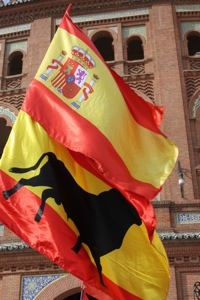
Then it was off to Las Ventas, the Madrid bull ring for what I suppose was the highlight of the day. Certainly it was the most memorable experience of the day – highlight probably isn’t quite the right word to use. Our summation afterwards is that it was an experience that we can now say we’ve had, but it is 99.9999% likely that we will never feel the need to repeat it. A bullfight is different, that’s for sure, and is it part of the way of life in many parts of Spain, but is it a pleasant experience? No, not really…..and that’s just from a newly initiated spectator’s point of view. The perspective from the bull’s standpoint is even less positive of course. Interestingly, we’ve since discovered that the Spanish are not universally in support of bullfighting – it’s banned completely in some parts including Catalonia, and it’s only rarely practiced in many others. It’s really only in the centre of the country around Madrid, and in Andalusia in the South, where it is reasonably popular.
(Another interesting point – in Portugal, the bull doesn’t die….in Spain however, he lives in only the rarest of cases when the matador feels the bull has been such an honourable opponent and has fought so bravely that his life is worthy enough to be spared. But, given that this would by definition mean the matador conceding that he, the human, had been outsmarted by a mere animal which would be a considerable blow to the obviously huge ego the matador brings to the event, it is a VERY rare event indeed.)
I think the pictures attached will tell enough of the story, but here’s a summary of a Spanish bullfight – there are six fights, two bulls each for three matadors. Each fight is divided into three parts or tercios, after a ceremonial parade of the (human) participants, being the matador and his entourage consisting of 2 picadores on horseback, 3 banderillas and a sword page. Each third is announced by a bugle blast:
:: the “lancing third” where the matador and his banderillas work out the bull’s strengths and weaknesses, traits and quirks, by testing him with manoeuvres using the gold and magenta capes. We noticed that the banderillas spent most of their time ducking for cover behind the heavy wooden barricades around the ring – they only appear to be brave when the bull ISN’T targeting them personally! Towards the end of this third, the picadores enter the ring on their horses which wear very heavy protective coverings because the bull’s natural instinct is to gore the weaker animal and try to disembowel it. (Until the 1930s, the horse was not protected at all, so consequently the horse death rate at Spanish bullfights was always higher than that of the bulls!). The picadores job is to get into position near the bull and lance it in the back to weaken it and start it losing blood.
:: the “third of banderillas” where the matador and the banderillas anger and agitate the bull further, and seriously get the blood flowing, by each attempting to plunge two sharp barbed sticks into the bull’s back.
:: the tercio de muerte (the “third of death”) which is just the matador alone against the bull – the former armed only with his muleta (red cape) and an estoque simulado (a light sword usually wooden or aluminium). A number of cape flourishes take place, the closer to the bull the better, with the intention being to wear the already weakened bull down even further, and eventually leading to the matador changing to his estoque de verdad (“real sword”) and, after facing the bull head on, plunging the sword between the bull’s shoulder blades and through its heart.
There’s a bit more bloodthirsty stuff after that but the end result is an ignominious exit for the bull, dragged out by one horn behind a couple of horses, a raking up of the bloodiest sand by the bull ring staff, and a strutting egotistical lap of honour for the matador who “earns” the cheers and applause of the crowd. And if he’s been especially good in his effort, as admittedly one of ours was with a great deal of showmanship in his performance, the crowd all wave white hankies and ask for the matador to be awarded one of the bull’s ears!
The rest of the evening had the potential to be a little subdued after that, but we decided to put it all down to experience, and took the Metro back to the Teatro Real district for dinner at a very nice restaurant (I had a steak, just to prove I was over the bullfight!), then the return two bus trips back to a well earned rest in our home away from home.
All in all, a very interesting and worthwhile day in the Spanish capital – you’ll find a few photos if you click here



 The Moffats on Tour Blog