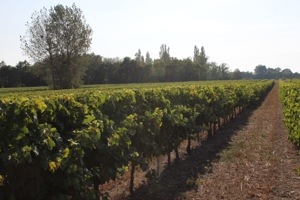
Four Bridges in Four Days

Something that the South of France has in abundance, apart from olives, grapes, lavender and film stars, is bridges. Yes, bridges! We won’t list them all, but here’s a few notes about the four rather special ones we visited along with Katrina recently…..

Tuesday – Pont Julien
This was one we’d visited with Lawren back in 1998 but a month or so ago when we were in this area with Patricia, we couldn’t find it! However, this latest time we located it straight away. The Pont Julien is near Lacoste in the part of Provence made famous by Peter Mayle in his books, and it’s been there for over 2000 years. In 1998 we drove over it, in a car obviously, but following in the wheel tracks of the Romans who’d built it in 3 BC to use it in their chariots. It turns out now though that the local authorities decided in 2005 to build a new bridge alongside in order to preserve the old one, so our plan to drive a camping car over a Roman bridge was thwarted! We walked over it instead – but it’s quite fantastic to think that this was a bridge that was in daily road use for 2008 years…..one of those things that New Zealanders find a little hard to comprehend at times!

Wednesday – Pont d’Avignon
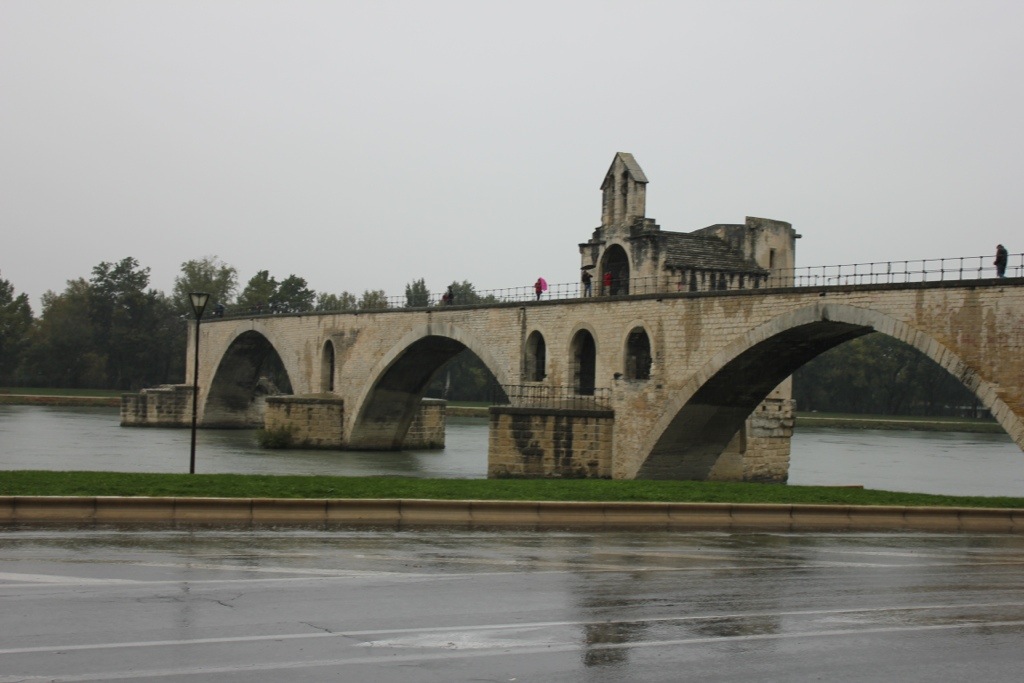
Funnily enough, despite the fame generated through the well known song, this is not the real name of this medieval bridge – it is actually officially known as Pont St Bénezet, named after the local shepherd boy (later canonised) who was told by an angel, according to the legend, to build the original bridge. And while we’re dispelling myths, the song may well mention dancing on the bridge as in “sur le Pont d’Avignon”, but it was originally “sous le Pont” meaning under, because the dances were traditionally held on an island in the middle of the Rhone where the bridge passed over.
Anyway, we certainly didn’t dance on or under or even anywhere near this bridge, because it was absolutely pouring with rain and blowing a gale, so even to walk out on it was a pretty impressive effort. It’s only 4 spans long these days so the walk wasn’t that far…..not nearly as far as it would have been back in 1185 when it was first completed as a 900m long bridge of 22 spans. That’s the thing that is most impressive – that back in the 12th Century they had enough skill to build a bridge that long over such a major river. Mind you, perhaps they weren’t that good because it suffered badly in the frequent floods and often had to be repaired, so became more and more patched, until in 1668 it was finally almost completely destroyed by a catastrophic flood and was taken out of commission. Because they stopped bothering to try and repair it after that, bit by bit the remaining parts of the bridge fell down, until there were only the current four spans left. And that’s how it stands today – a legendary bridge, but one that leads to nowhere!

Thursday – Pont du Gard
This one is another bridge that leads to nowhere….not today anyway. When it was built in the 1st Century AD, again by the Romans, it was part of a 50km long aqueduct system that carried water to the city of Nîmes. Interestingly enough, the word is that the citizens of Nîmes didn’t really need the 44 million gallons of water that the aqueduct delivered to them every day – they had plenty already, and the extra water simply enabled them to waste it in luxurious living with running water in every home, flushing toilets, swimming pools etc – the good life Roman style!
Even although by the 6th Century the water system had largely ceased to function, the Pont du Gard still operated as a very important (and lucrative) toll bridge for over 1000 years, and today it is probably just as lucrative as a tourist attraction. The day we were there, the car park was at least half full (which is a lot of cars and camper vans) and there were visitors everywhere, despite the fact we are now very much in the low season. And no wonder – it is indeed a sight to behold, as it is a very impressive piece of engineering. Imagine the skills involved nearly 2000 years ago, to build a bridge structure that contains over 50000 tonnes of limestone, some of the blocks weighing over 6 tonnes each – and it is built almost entirely without mortar! The quarrying and preparation was so precise that the blocks fit together mostly by friction and gravity alone – quite amazing really when you consider the overall size of the bridge at 49m high and 275m long. And one more engineering fact – the surveying was so precise, to ensure the water could flow evenly along the full 50km length of the aqueduct, that the fall across the Pont du Gard itself is only 2.5cm, which is a gradient of 1 in 3000! That’s impressive….

Friday – Viaduc de Millau
Even the Romans couldn’t have dreamt this one up! About 15 years ago, the French government decided that it was time to end the huge traffic jams that occurred around the Millau area every day during summer, and commissioned studies into an alternative route. Several options were considered with the final result being the incredible structure that now crosses the entire Tarn Valley, almost over the top of Millau and the now no-longer jammed roads below. It’s the world’s highest multi-stayed viaduct, with a steel deck and 7 concrete piers the highest of which is 343m. It’s nearly 2.5km long, and cost €400m. When it was under construction, which only took 3 years to the day incidentally, the crane operator working on the highest pier was in a cab 255m above the ground, which is the equivalent of a 76 storey building. And yet, despite these superlatives and even with all the modern engineering techniques and the complex computer modelling and analysis involved, guess what they used to ensure the pylons holding the suspension stays were vertical? A humble plumb-bob obtainable at the nearest hardware shop for a couple of euro!

With an average age of almost 1500 years, each of these structures is an engineering marvel of its day, and each is also now a significant tourist attraction. What a privilege it was to be in this part of the world in the first place of course, but also to be lucky enough to see these four special bridges over four special days…..

20121109-201153.jpg

20121109-201255.jpg

20121109-201305.jpg

20121109-201246.jpg

A couple of highs….

Well, we’re back into the blog posts now….there’s one coming on some bridges in the South of France, and it’s probable that there will be another one soon about our week or so in three parts of what used to be Yugoslavia (Croatia, Bosnia & Herzegovina, and Slovenia) because we enjoyed every minute of our time there (except for the one time – at 3.15am – when the torrential rain in Dubrovnik collapsed our awning, thus damaging it to the point where it will not work again without some fairly major repairs!). However, before all that, we want to tell you about a couple of mountains in Europe that are now special chapters in our book of travels.

By the way, this doesn’t include any peaks in Switzerland, because we could be forgiven for believing that there aren’t really any at all! Apart from the first afternoon there, as we travelled from a second visit to Vaduz in Liechtenstein to our campsite located halfway between Zürich and Luzern, when we were driving along a valley flanked by quite high ranges, the rest of our time in Switzerland was spent in low fog and mist behind which there may have been mountains…..who would know?

A few blog posts ago, we told you about our big effort in climbing Mount Kofel (1342m) above the village of Oberammergau in Germany. In the last two weeks, in our travels with Katrina and Bernard, we now have two more peaks to add to the list – Montecassino in Italy, and Kehlstein in Germany. Very different in height, very different in use, and each having occupants over the years who couldn’t be further apart in character if they tried, but both great places to visit.

We visited Cassino to firstly see the War Cemetery there, at the foot of the mountain and quite near the town. Andrew had been there in 1980 and remembered it as being a very peaceful place, where the memory of the several thousand Allied soldiers, including 400 or so Kiwis, is still held very dear by the eternally grateful local Italians. Well, in the ensuing 30+ years, the town and its industry have grown around the cemetery so the surrounding area is a lot busier now, but the graves themselves still sit peacefully under the trees and remain an oasis of memories. After a good visit there, we headed into town where a policeman with just “a leetle bit of Inglese!” assured us that it was no problem to take the camping car up the winding road to the Abbey at the top of the hill, but that we would not be allowed to camp overnight. That was OK with us we only intended to make a brief visit, then head on to a camp on the way to our next destination which was the ferry port of Bari.

So off up the hill – a 9.5km drive that probably covers only about 500m as the crow flies, from the town at just 40 metres above sea level, to the Abbey car park at 517m a.s.l., and on a very good road! In Italy, this is quite surprising because most highways and byways, apart from the toll roads, range from poor at best to absolutely dreadful. And when we got to the top, another surprise was in store….the old guy who took our €8 for parking informed us, quite unprompted, that we were most welcome to stay the night in the car park so we decided to accept this offer. First of all though we visited the Abbey itself – a pretty incredible building which has been there in one form or another since St Benedict founded it in the 5th Century AD and which has been destroyed and rebuilt so many times. Most recently it was reduced to rubble in the Battle of Monte Cassino in the first few months of 1944 – this battle of course being the reason for the cemetery down below – but then it was fully rebuilt within a few years after WW2 ended. It’s still a fully functional Benedictine monastery and in fact we were in the church itself when evening prayers were being sung which was a pleasant surprise. And then, next morning after a very peaceful night’s sleep under the walls of the Abbey, we were all still sound asleep when morning prayers began. And how do they wake the monks? (and also the heathens in the car park?)….by ringing the incredibly deep toned and resonant Abbey bells for a full 10 minutes starting at 5am….and again at 5.30am, and then again, just in case any young novice has pulled the blankets even tighter around his ears, at 6am! Despite what you may think though, it was actually a really good experience – not many people like us would have stayed the night “up the hill” anyway, let alone had the experience of lying there, listening to the bells toll out across the surrounding countryside. Unique…and memorable. The other thing that made the stay even more memorable, was to look out the windows to find ourselves well above a thick and all-enveloping layer of cloud which obscured absolutely everything bar the Abbey itself and maybe the top 50m of the Monte. We certainly felt like there was no-one in the world bar just us four, a handful of monks, and maybe God himself, on top of a pretty special peak.

Then, to see another famous peak but one at the far distant end of the spiritual scale, a couple of weeks later we camped in the town of Berchtesgaden, in the Bavarian Alps. It is a typical German Alpine town, where all the houses have shuttered windows with flower boxes full of geraniums, and all the occupants (well, many of them anyway) wear dirndls or lederhosen. But unlike most German Alpine towns, this one has a very close link to the Führer himself, as Berchtesgaden sits underneath a peak named the Höher Goll, which has Kehlstein as a sub-peak – this is where the infamous Kehlsteinhaus or Eagle’s Nest as we know it in English can be found. The town is at around 700m a.s.l., and after a short drive to a car park beyond which no private vehicles have been allowed since 1952, we boarded a bus which then became part of a convoy of 4 or 5 others which travelled 6.5km up another very good road at surprising speed as we climbed to almost 1700m a.s.l. The buses are on a very strict timetable because the road is one way for its entire length all but a passing bay at the halfway point where the downhill buses wait for the uphill convoy. Once we reached the top bus park, we achieved the next 124 metres of vertical climb in a very highly polished brass lift which takes you from a tunnel bored into the mountain, and up into the Eagle’s Nest building itself. And we were told that whilst we have to walk the length of the tunnel these days, Hitler used to be driven to the lift door….nice for some!

The Eagle’s Nest itself now houses a bar and a restaurant and to be honest is a somewhat unremarkable building in design terms – if it had been built on a normal building platform. However, given that it, and the road leading to it, were completed in just 13 months as a 50th birthday gift for Adolf in 1938, and that of course the site is nearly 6000ft up in the mountains, the unremarkable becomes worth noting! What is truly worth the climb though, and we were lucky with a clear sunny and mild autumn day, is the view down over Berchtesgaden and Konigsee, and across the valley into Austria where Salzburg was clearly visible. You can see a very long way from the Eagle’s Nest, and the view is magnificent. Check it out, along with a few other photos, in the attached album here.

Two entirely different peaks, but definitely two highs on our travels to date…..

List of Things We Don’t Like About France…..

OK, so the real purpose of this post is to let you know that we are alive and well! We know it’s been ages since the last blog post but that’s because we’ve been having far too good a time to sit around writing stories on an iPad!!

We have been travelling with Katrina and Bernard, our good friends from Wellington, and have had a wonderful time together since picking them up four weeks ago at Milan Airport. Since then, we’ve travelled through parts of Italy including the lakes in the north and the Cinque Terre, across the Adriatic to Croatia where we really enjoyed Dubrovnik and Split in particular, up through Slovenia and Austria to Germany, then onto Switzerland for a few days. Then, last week we farewelled Bernard in Geneva as he had to get back to NZ for work but Katrina is still with us “on tour” – we have had a great few days showing her some of our favourite areas in the South of France. We’ll drop Katrina off in Paris on Wednesday, and at 8am the next morning we catch a EuroShuttle and leave the Continent ourselves to head back to the UK after almost 5 months on this side of the Channel.

So, yes, we are fine and we are still enjoying ourselves very much. There’s a few blog posts in various stages of completion because we have so much to share, but for now, let’s just share the list of the things we can’t stand about the country we have now been in six times this trip, for a total stay that will amount to more than 7 weeks by the time we finally leave.

Here’s the full list of “List of Things We Don’t Like About France…..”
1. nothing

We’ll be back as soon as possible with stories about bells, Bosnia, and bridges among other things. TTFN.

Un día en Madrid…

Sunday 16 September…..Madrid, Spain

Well, it’s been over a fortnight now since the last blog and we’ve done and seen a lot of interesting things since (remind us to tell you in due course about apes on a rock, cork off a tree, flamingoes in a lake and the difference between green and black olives), but we wanted to tell you about the day we spent in Madrid recently.

Our camp was about 30km to the west of the city but there was a bus stop right at the gate, and after a longer than expected wait because the camp’s bus timetable was, naturally, not the same as the bus company’s timetable, we managed to catch the necessary two buses into the Pio Principe bus station in Madrid. Then, after the usual orientation issues which arise when you emerge into daylight from an underground bus or metro station and have no idea at first where the “top of the map” is, we headed off walking towards the older part of the city. We have really enjoyed the old, historical parts of every European town we’ve been to – there is just so much more character and life to those parts than there is in the more modern developments, no matter how spectacular the “new” architecture is.

By the way, a little aside here: we found out which direction to walk from a friendly Spanish policeman who not only spoke pretty good English, but was very tolerant as he answered questions from several tourists in a row. This was our first direct encounter with the Spanish police – we’ve now had three, and each one has been excellent as they’ve all been extremely pleasant and helpful. We even got a police escort through the town of Ronda in Andalusia when the cop we asked for parking advice decided it would be easier to get us to follow him rather than give us the directions! Just a pity he didn’t see the need to turn his lights and siren on as well…that would have been impressive! All in all (so far) top marks to the Spanish police…..a far cry from the gun-toting, ticket-issuing, campervan-impounding lot we’d been told to expect that’s for sure.

Anyway, back to our day….a quick stop for coffee, then on with our walk. We’d read about a couple of suggested walking tours but decided to create our own. First stop, Plaza del Carmen (you should always visit places named after family members, and also that was where we had to collect our pre-ordered bullfight tickets), then off to Puerto del Sol. This is one of the main squares and contains Spain’s “Kilometre Zero” from which point all official distances in the country are measured. The square also contains any number of street artists….living statues (best ones that day: the twosome of a 19th century African explorer taking a photo of a native woman; the man with no head; and the absolutely outstanding guy who was playing the part of a baby in a pram), buskers, a man who REALLY had no arms but who held his coin collecting cup in his mouth and still managed to talk at the same time, plus assorted beggars and other various forms of con artist.

Next main stop, after a wander through Plaza Mayor, was at the Rastro Markets in the south of the old city. This is an overcrowded, rambling and chaotic Sunday marketplace, with hundreds and hundreds of stalls, thousands of shoppers where you can buy almost anything you can possibly imagine: clothing, shoes, souvenirs, pots, pans, pocket watches (not working, most without hands in fact), antiques, food, tools, CDs, sunglasses….the list is almost endless! It is a bit too much really! Jostling and shopping completed, we needed food so headed to a quieter part of the city for lunch – warning: don’t order “Pie of the Day” in Madrid without the precaution of finding out what it is first…..otherwise you might get the “cold tuna” special, and it will not really be very nice!

Then, as one of us had sufficiently recovered from the morning’s shopping, it was time to try some more, this time in what appears to be Spain and Portugal’s largest department store: El Cortes Inglés. Quite bizarrely, that name translates directly as “The English Parliament” but I have no idea of the history here – although the store certainly appears to be a lot more organised than any Parliament that I know of. The only thing of interest that I remember from the shop was the imitation rugby jerseys on special, with an Australian flag and a logo proclaiming “Australian Rugby – AUCKLAND”.

Getting a bit hungry again, so we called at St Gines Chocolate Shop which sells, according to the advertising, the world’s best churros which, for the uninitiated, are long deep fried pastries. We quite like churros, but are more used to the ones just dipped in cinnamon and sugar…..these ones however, came with a cup each of rich dark hot melted chocolate. Mmmmmmmmm! Good for you of course, absolutely no calories at all. And we’d done a lot of walking that day, so it was more a essential snack than a luxury!

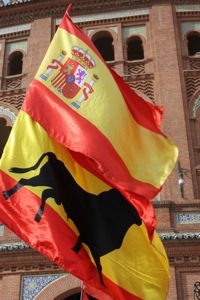
Then it was off to Las Ventas, the Madrid bull ring for what I suppose was the highlight of the day. Certainly it was the most memorable experience of the day – highlight probably isn’t quite the right word to use. Our summation afterwards is that it was an experience that we can now say we’ve had, but it is 99.9999% likely that we will never feel the need to repeat it. A bullfight is different, that’s for sure, and is it part of the way of life in many parts of Spain, but is it a pleasant experience? No, not really…..and that’s just from a newly initiated spectator’s point of view. The perspective from the bull’s standpoint is even less positive of course. Interestingly, we’ve since discovered that the Spanish are not universally in support of bullfighting – it’s banned completely in some parts including Catalonia, and it’s only rarely practiced in many others. It’s really only in the centre of the country around Madrid, and in Andalusia in the South, where it is reasonably popular.

(Another interesting point – in Portugal, the bull doesn’t die….in Spain however, he lives in only the rarest of cases when the matador feels the bull has been such an honourable opponent and has fought so bravely that his life is worthy enough to be spared. But, given that this would by definition mean the matador conceding that he, the human, had been outsmarted by a mere animal which would be a considerable blow to the obviously huge ego the matador brings to the event, it is a VERY rare event indeed.)

I think the pictures attached will tell enough of the story, but here’s a summary of a Spanish bullfight – there are six fights, two bulls each for three matadors. Each fight is divided into three parts or tercios, after a ceremonial parade of the (human) participants, being the matador and his entourage consisting of 2 picadores on horseback, 3 banderillas and a sword page. Each third is announced by a bugle blast:
:: the “lancing third” where the matador and his banderillas work out the bull’s strengths and weaknesses, traits and quirks, by testing him with manoeuvres using the gold and magenta capes. We noticed that the banderillas spent most of their time ducking for cover behind the heavy wooden barricades around the ring – they only appear to be brave when the bull ISN’T targeting them personally! Towards the end of this third, the picadores enter the ring on their horses which wear very heavy protective coverings because the bull’s natural instinct is to gore the weaker animal and try to disembowel it. (Until the 1930s, the horse was not protected at all, so consequently the horse death rate at Spanish bullfights was always higher than that of the bulls!). The picadores job is to get into position near the bull and lance it in the back to weaken it and start it losing blood.
:: the “third of banderillas” where the matador and the banderillas anger and agitate the bull further, and seriously get the blood flowing, by each attempting to plunge two sharp barbed sticks into the bull’s back.
:: the tercio de muerte (the “third of death”) which is just the matador alone against the bull – the former armed only with his muleta (red cape) and an estoque simulado (a light sword usually wooden or aluminium). A number of cape flourishes take place, the closer to the bull the better, with the intention being to wear the already weakened bull down even further, and eventually leading to the matador changing to his estoque de verdad (“real sword”) and, after facing the bull head on, plunging the sword between the bull’s shoulder blades and through its heart.

There’s a bit more bloodthirsty stuff after that but the end result is an ignominious exit for the bull, dragged out by one horn behind a couple of horses, a raking up of the bloodiest sand by the bull ring staff, and a strutting egotistical lap of honour for the matador who “earns” the cheers and applause of the crowd. And if he’s been especially good in his effort, as admittedly one of ours was with a great deal of showmanship in his performance, the crowd all wave white hankies and ask for the matador to be awarded one of the bull’s ears!

The rest of the evening had the potential to be a little subdued after that, but we decided to put it all down to experience, and took the Metro back to the Teatro Real district for dinner at a very nice restaurant (I had a steak, just to prove I was over the bullfight!), then the return two bus trips back to a well earned rest in our home away from home.

All in all, a very interesting and worthwhile day in the Spanish capital – you’ll find a few photos if you click here

20120929-133253.jpg

Passions of France

No, not “passion in France” – sorry to disappoint you – but a blog to tell you all about a very special kind of place where we’ve been staying as we travel around France in our camper van. When we picked the van up in the UK, we also collected a number of European campsite guidebooks to take with us. We’ve used them all – either to find a fully serviced camping ground when we need all facilities like Wi-Fi, washing machines and dryers etc., or to find an “aire” which are the free places like motorway laybys, service stations, truck stops, rest areas etc. But the best book of them all and the one we’ve used on a number of occasions recently, is the one entitled “France Passion 2012”. This has opened up some wonderful doors to us – doors that could be up to 500 years old as we’ve discovered – and doors that lead to some extremely interesting experiences.

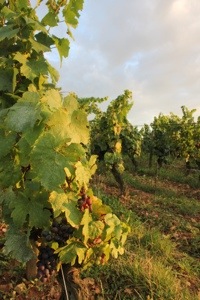
What is this all about? Passions are locations all over France….1700 of them in fact….where self sufficient camper vans are welcomed for an overnight stay. Each location offers a friendly invitation to motorhome owners to come and stay, whilst the property owners carry on their normal day to day activities. So, you park your van on the property, usually ‘out the back’ somewhere – tonight for example we are under the willow trees which are less than 20m from sixteen hectares of Merlot, Cabernet Franc, and (a new one to us) Ugni-Blanc Grapes – and then learn about what the property is all about, what the people do, what they produce and so on. The hosts are farmers or wine growers primarily, but between them all they cover every aspect of French rural life. And of course there’s the opportunity to sample and buy some of their product, but there’s absolutely no obligation to do so, so therefore no need to sneak away before dawn the next day to avoid the shop! In most cases there are no services offered which is fair enough when there’s no payment expected, but some will have rubbish disposal, water, occasionally electrical hook-up, and maybe even toilets, especially if the property is also a commercial premises like a vineyard offering tastings and meals.

We have been hosted now on seven occasions, from the Pas-de-Calais region in the north on our very first night in Europe back in mid-June, to a vineyard in the Var region of the South. Here’s a brief idea of the variety of places we’ve enjoyed….
:: a vegetable grower (légumes de saison) on the very edge of the village of Locon, near Béthune in Pas-de-Calais. This was our first place, and where we first encountered the very European concept of farms being right on the edge of urban areas….in this case, as you viewed it from the road the 50ha of vegetables were to the right of, and behind, the owners’ house, whilst to the left of the house was the village hairdresser’s salon and then 150m of houses leading up to the church and the village square! And beside the implement sheds out the back was where we parked up, and had a very peaceful meal and overnight sleep in the tranquil French countryside. Next morning, we stocked up on freshly dug new potatoes, beans, garlic and tomatoes (at extremely cheap prices too!) before we headed off.
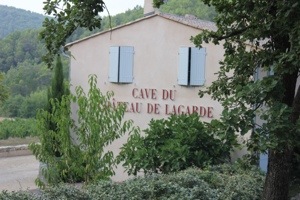
:: the Cave du Chateau de Lagarde, a rosé wine and olive oil producer near Fignieres in Var not far from Cannes. This one was the carparking area of a wine tasting boutique, in a new building made to look old. Corinne, the hostess, was a lovely lady who was very enthusiastic about the wines she produced, and who not only allowed us to taste them all, but gave us the remainder of the bottle of rosé which we’d just sampled from! Next day before we left, of course, we went back into the shop, and came away with a very tasty jar of pear jam, a bottle of olive oil which will keep us going for months, and another bottle of the rosé!
:: two days later, we changed grape varieties and parked alongside the sheds on a Beaujolais vineyard at Lachassagne, north of Lyon in the Rhône region. We not only met the owner in the very well stocked shop the next morning, but also met her dog Saturn who showed us what a clever boy he was with his tricks. (The owner, finding out we were from Nouvelle Zealande, rang her sister in law from Avignon and got us to talk to her….a Kiwi who has lived in France for 22 years and still has her NZ accent). Possibly bemused by the dog’s antics, and definitely intoxicated by the sheer notion of having spent the night in a Beaujolais vineyard (this time right smack bang beside the first row of vines) we managed to buy a couple of bottles, plus some locally produced goat’s cheese. And here’s a fact you may not know – Beaujolais isn’t just a red wine…..they have a white variety and a rosé as well. All you real wine connoisseurs out there will of course know that, or at least say you did, but we will be honest and admit that we didn’t know so once again, this trip has expanded our knowledge base! And the taste of both the wine and the cheese? Très magnifique!!
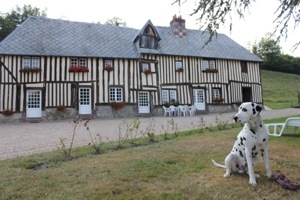
:: change of drinks now, with two properties in the Calvados region of Normandy both located on 10 or so hectares of orchards growing apples and pears, and both with the owners living in homes first built in the 1600s! (And one, Le Lieu Chéri near Lisieux, was complete with a “wine dog” as well, a Dalmatian youngster named, we think, Garayon). In both places they use a process that is hundreds of years old to turn the fruit into juice, cider, Pommeau, or a cognac-like drink named after the region, Calvados. The process includes steps like letting the apples fall to the ground and picking them up from there rather than from the branches, and then juicing the entire fruit all bar one part. The skins, stalks, cores – everything goes in the mix….all except the pips which are definitely excluded as they are too bitter. We tasted all the resulting varieties, and they’re all great, but as there are limits to both our budget, and also the the carrying capacity of the camper, from the first place we only bought some pear cider and a bottle of Pommeau (an aperitif made from 3/4 apple juice, 1/4 Calvados and then left in an oak barrel for 3-4 years without any fermentation….as opposed to the Calvados itself which is fermented juice that has been aged in oak barrels for up to 30 years) and from the second a jar of Confite de Cidre au Calvados, plus a small bag of caramels which taste kind of like Jersey Caramels and are made from their fruit jam and milk. Come to think of it the Channel Islands including Jersey are not far off the coast of Normandy, so there’s probably every good reason why caramels from Normandy should taste like those from Jersey!
:: the next place was a real gem – owned by an artist originally from England named Diane who has set up a studio in a tiny village named Leimburel in the centre of the Finistère region of Brittany. We intended to stay the usual one night but had such a great time, and Diane and her friend Yvon (and the dogs Islay, Ruby and Tiki) were such wonderful hosts, that we stayed two nights and have now made friends for life. Purchases here weren’t quite so important – it was so much more about the friendship made, and the instant rapport that we found there – but we did buy some very tasty garden vegetables (courgettes, runner beans, tomatoes and the best strawberries in France!) plus a small watercolour of some pigeons. The painting is significant because everywhere we have been there are always pigeons cooing, so much so that we’ve decided they are actually our guardian angels in disguise, and therefore to find them in a watercolour of Diane’s was just a purchase waiting for us! Our parking spot here was on the grass near the studio, alongside a large paddock of clover which was where Diane’s bees were as busy as…..um, bees. And another little note about this place – the village of Leimburel is a delightful place which used to have 110 inhabitants living in 25 houses, but with the gradual depopulation of rural France as people move to, and over-populate, the cities, Diane is now one of only three people – total – left in Leimburel. It is a crying shame and if it wasn’t for the ridiculous tax and property laws in France, we’d just about be tempted to buy one of the old houses and live there ourselves! If only!!
:: and the property we are in now which produces Pineau des Charentes and 5, 10 and 20+ year old Cognac! (yes, back to the booze!). This one is near Asnierès-la-Giroud north of Bordeaux, the house is only 150 years old, and they make very nice products from the 30ha of grapes which are just about to be harvested by a huge machine which we were proudly shown, after our little pre-dinner tasting session. There’s a similarity to the Calvados process – just as Pommeau is apple juice and Calvados, Pineau is grape juice and Cognac….and Cognac itself of course is the fermented, distilled end result of grape juice.

We have seen some wonderful, off the beaten track sights and places; have been hosted by some lovely people; we have tasted and sampled some very tasty food and drink; we have learned so much about how things are produced; and in the process have really experienced the best of France. Forget Paris! If you come to France and, oh yes, if you’ve got a camper van, then try the France Passion system – you will absolutely love it!

We’re off to Spain and Portugal now (via a cheese place down near Bayonne), but we’ll be back in France again in a few weeks, and then again in November – who knows what new experiences we might be able to add to the list! Watch this space….

20120910-002030.jpg

20120910-140542.jpg

20120910-140615.jpg

20120910-140625.jpg

20120910-140637.jpg

20120910-140718.jpg

20120910-140727.jpg

20120910-140735.jpg

Travelling with Patricia

Hi, it’s Pauline here. This blog is mostly aimed at the friends and family of my sister Patricia (or, after a week in Paris…..Pa-tree-zee-ah as she now thinks it should be pronounced). Of course, you’re all welcome to read about her adventures with us – we just thought that now that Patricia has gone home, we should put our version of events on line in our own defence. So, here comes a bit of a travelogue, recounting some of the events of the past four weeks since we knocked on the door of her Montmartre hotel room door in Paris where she’d had a few days on her own first, and took her on a tour of Europe (well, some of it anyway!). There’s a few pictures of “Travels with Patricia” attached as well…..click here

We started with a return to the first camp we’d stayed in back in mid-June, in the Somme area of northern France after a visit to a supermarket to restock the van, and a quick trip back to a couple of the war memorials we’d seen earlier but wanted to share with our new tenant. After dinner that night, the first live attempt to make up the second bed in the van….and very successful we were too. So successful unfortunately, that Patricia obviously decided that she couldn’t do any better than Andrew and I at it, so left us the job every night for the next 4 weeks! Katrina and Bernard, you’ll be pleased to know though that the bed making and unmaking is a breeze and the bed itself is reportedly very comfortable.

Our next stop was a quick trip back to Bruges which we’d thoroughly enjoyed the first time and felt sure Patricia would also really love the old medieval buildings, the town square, the canals and the boat trip. We weren’t disappointed as she did appreciate all of that – what we hadn’t counted on was the liking she took to the local beers. Admittedly it was a very hot day, but really!! Eventually though, we prised her away from the Beer Wall (a bar which supposedly sells every one of the 1300+ beers brewed in Belgium) and headed for Bruxelles. The plan there, or in nearby Leuven, was to catch up with another of our Clemenger cousins but sadly that didn’t happen due to some illness on their part although we hope to get back to Belgium later in the trip to see Emma and her family. Instead, we had a couple of quiet days near Bruxelles and then a very nice visit to Leuven for Sunday lunch and a walk around the very old cobblestoned streets near the cathedral. It looked a lovely old town, and Patricia really appreciated the chance to see where some of her ancestors had originated from.

We then spent a night in country #3 – Luxembourg – before heading on to Germany and a couple of nights in a camp on the banks of the Neckar River a few kilometres from Heidelberg. On the day in the city, we purchased Heidelberg Cards and were tourists for the day – eating apple strudel, visiting the very old Heidelberg Schloss (and incidentally as part of that, the unlikely but extremely interesting Museum of German Pharmaceutical History!), walking across the Old Bridge, going up to the castle on a funicular railway and then walking down, and then chancing upon an organ recital in an old Church below the castle which was really good. All in all, a good visit to a very nice town, and a place which Patricia really enjoyed.

The next day took us in the morning to the Sinsheim Aviation and Transport Museum which we all enjoyed (highlights maybe being the Air France Concorde and the Russian Tupolev-144 aircraft on display that you could go into) and then in the afternoon on a three country sprint from Germany into Switzerland where we couldn’t find a camping spot and then into Austria where we could, at Bregenz. We kept the run of countries up the next day by going back into Switzerland briefly (don’t tell the authorities though, cos we didn’t buy a windscreen ‘vignette’ to allow us onto the autobahn), quickly through Liechtenstein where we had lunch and got a stamp in our passports, then back into Austria, before crossing the Ehrwald Pass back into Germany to visit Neuschwanstein Castle before calling it a day. All in all, we travelled 370km that day when, had we just gone from Bregenz to Neuschwanstein direct, the trip would only have been 103km!

You know some of the story of the next few days, when we visited Oberammergau – went to a German play and climbed a German mountain – and then spent one more night in Austria where we visited Salzburg and enjoyed a full range of music from Mozart to Rodgers & Hammerstein. We then headed south to Italy and had some great times showing Patricia Venice, San Marino (that was European country #9 for her), Tuscany (the countryside in general, Florence in particular), and then Rome. In Rome, the van started to fall apart and so, coincidentally, did Patricia! Well, that’s a slight exaggeration but she did insist on not wearing a hat on our big sightseeing day and the combination of a lot of walking, seats on the open top deck of the “Hop On, Hop Off” bus, and a temperature in the high 30s all combined to take a bit of a toll! However, she survived (as did we) and could add places like St Peter’s, the Vatican Museums and Sistine Chapel, the Trevi Fountain and the Colosseum to her list of touristy tick-offs.

The problems with the van which couldn’t be fixed locally because most of Italy closes for August and also a sense that we were running a bit short on time after being in Bavaria and Austria for longer than we’d planned, meant that we put our nose down and tail up and got back to France as quickly as possible. That then gave us Patricia’s last full week to spend enjoying France – and we did just that!

We made the most of being in one of our favourite parts of the world – the South of France – and made sure Patricia got to see places like Monaco, Nice, Grasse, Apt and Gourdes. We stayed in a couple of camps, one near Nice and the other right at the top of the hill above Gourdes which many of you will know is one of the most picturesque (and most photographed) villages in France. In between those spots we had a night in a “France Passion” which is one of a series of free camping spots in rural France and which I think will be the subject of Andrew’s next blog post – this one was on the property of an olive oil and wine producer at Fignieres in Provence.

After Gourdes we headed north on the Autoroute to Lyon and encountered the bouchon which we learned means traffic jam in French slang. This involved nose to tail traffic in all lanes, both ways, for many many kilometres which held us up for hours and completely defeated the purpose of paying the toll and using the supposedly faster route that day! The bouchon is caused by a unique French summertime custom – all rental holiday homes in France, of which there are tens of thousands, are rented by the week, from 4pm Saturday to 10am the following Saturday during the peak season. Consequently, everyone using such accommodation is either travelling to or from on Saturday afternoon….and we got well and truly caught in the ensuing chaos! Anyway, we eventually reached our destination and spent a night in another “Passion” vineyard (this one in Beaujolais country) which was a great experience – the next day we moved further north via more delightfully picturesque French countryside to a camp on the banks of the Loire River at St Saur.

After that, all we had left to show Patricia was a bit more of Paris so we spent a day at Paris Disneyland and a day and a half on the tourist trail in the city, adding the Tuileries, l’Opera, the Eiffel Tower, Notre-Dame, the Champs Élysées etc etc to the list. We also found time for some nice dining including a return visit to a place we visited in 2009 – Le Procope which is the oldest restaurant in Paris and where Napoleon used to eat!

Oh, speaking of restaurants, we met the owner of a creperie in Montmartre…..but that’s a story that Pa-tree-zee-ah will have to tell you herself if she chooses to. What goes on tour, stays on tour!!

The Caravan of Life

We thought it was time for an insight into the Travelling Dilberrys caravan of life i.e. the actual vehicle which has been our home now for over 11 weeks. This blog was due anyway, but a series of unfortunate events in the last few days has brought the subject to top of mind. It all started with a wonky awning, and whilst it hasn’t ended yet, it will do so in the next few days with any luck, but with a reasonable bill for a number of other totally unrelated parts of the motorhome. Or to be more precise, the “camping car”, which is what motorhomes are most often known as in Europe. (They are certainly not known as mobile homes which is a great relief when arriving at some camping grounds when there is a tariff sheet on display which suggests our overnight cost will be something like €80-100….rather than the usual €10-30….until you realise that “mobile homes” are not motorhomes like we are in, but removable houses which exist in little compounds in most campgrounds.)

Anyway, what’s happened lately? As mentioned, the awning that comes out from the side of the van had got a bit skewed and wasn’t locking into place, which is a potential issue as you can’t drive away with it like that. This is apparently a fairly common complaint and we NOW know is dealt with by having one person wind it in, and the other pull slightly on one side to ensure it winds it straight and locks in. At the time however, we (OK, insert the word “Andrew” in place of “we” there) tried to fix the problem with a screwdriver. Not a good idea! Not because the screwdriver itself did any harm, but the person on the end of it did! We ALSO now know that it is not a good idea to stand one foot on one of our Tesco outdoor chairs and the other on the back bumper of the van. Two discoveries here: firstly a supermarket outdoor chair CAN fold completely inside out (and then be reversed back into shape later), and secondly, the back right taillight housing unit on an Adria Coral 650SP is held on with only glue and just ONE screw! How ridiculous is that?

It is now currently held on however with about 200 metres of gaffer tape, and will remain so until we can get a replacement unit installed with a bit more permanency than the original. Fortunately, it’s only the housing and not the actual lights themselves as that would be REALLY expensive! But…..speaking of the actual lights themselves, there is the small problem of the back LEFT unit, which someone (not us I hasten to add) mysteriously and anonymously managed to crack at some stage recently, presumably in a carpark somewhere. It’s not too bad, but probably wouldn’t pass a warrant in NZ…..not sure about in the UK, when the “MOT” is next due.

The day after the bumper incident, we (Pauline) opened one of the cupboards in the bathroom. You know how the airline crews always warn you about taking care when opening the overhead lockers because items may have moved in flight blah, blah, blah? Well, the same warning should apply to camping car cupboards. A bottle of perfume tumbled out, dropped straight into the little basin and smashed a hole straight through it! Makes the basin a long way short of watertight, that’s for sure! Fortunately, and I know you’re all concerned about this, the perfume was unscathed! We’d already noticed that a previous owner of the van had used something to clean the basin which had discoloured it a bit and had also made it somewhat brittle – now we know just how brittle it was!

So replacement part number two is needed: a bathroom basin unit for a 2004 Adria Coral. Fingers crossed for our visits tomorrow (well, just one visit hopefully, not visits….) to local French Adria dealers that we may find both parts in stock and able to be installed fairly smartly.

Then there’s the minor things….
~ the kitchen window blind which will go up but not down again
~ the cover off the electrical socket on the outside which some Lithuanian vandal thought they’d quite like. They did leave half the hinge behind though, so I’m not sure how useful the bit they did break off is to them
~ the hole in the front windscreen blind which (yes, me again) I put in it in Sweden back in July when I thought it would be cool to have our New Zealand flag on display whilst the blind was up. Another idea which turned out to be not so smart in hindsight: how was I to know that when I accidentally let the corner of the flag slip a little, the eyelet in that corner would wind in with the blind, which then became utterly immovable in either direction? And how was I to know that the only way to get it out – using a combination of brute force, an egg slice and yes, you guessed it, a screwdriver – would leave holes in the blind when I eventually did get it to unroll as designed?
~ the additional racing stripes added to the side of the van the other day when the trees along the side of the driveway at a campsite at Gourdes in the South of France proved NOT to be the type that bend gracefully out of the way and just wipe any excess dust off your vehicle, but more the type that are competely unyielding and are designed to remove paint rather than dust! Hopefully a cut and polish will minimise that one….time will tell.
~ when you open the side door, and want it to stay open, you can click it into place with a catch on the door that clicks into a holder on the outside wall. That worked perfectly well – once! The first time we used it and then wanted to close the door again, one of us (me, quite probably….OK, yes it was me!) pulled the door as it is designed to be pulled, and with it came not only the catch as expected, but the holder and the two screws as well! That was on day 1 – today is day 80 and I still haven’t fixed that one. I have however invented a little string thing that keeps the door open perfectly well!
~ last but not least, the side hatch which leads into what we call “under the house” which is the large storage locker under the bed but accessible from outside where we keep our suitcases, our supplies of bottled water, wine, toilet paper, the outdoor table and chairs, the 25m electrical cord, an empty gas cylinder, pegs, a clothes rack, the toolkit (complete with screwdrivers as you’ll have noted), the water hose, a sign which you use to reserve your spot when you leave a campsite (that one is on long term loan from the most expensive camp in Scandinavia – it was the least they could do after charging us like wounded bulls to stay in their camp). Anyway…the hatch. This is how it works….it stays open on its catch perfectly well for hours on end when no human is nearby, but as soon as one of us sticks our head in the locker to get something out – whammo! Down comes the hatch, with considerable weight and force, right onto your head!

So enough of all that….these are all minor things really when viewed in the context of 15,292km so far across 20 European countries – the campervan actually performs really well: it has the most comfortable bed, heaps of storage so we have a nook or a cranny for everything, a compact but perfectly adequate bathroom (albeit with a self draining basin at present), very reliable and smooth running mechanics, it uses next to no oil, we get 25 miles to the gallon of diesel, it comes complete with an efficient driver and a gourmet cook both of whom can, but rarely do, understudy each other, and it’s our home! We like it very much, and will miss it come the end of January!

Oh, and one other thing it comes with….the new female in my life, Karen. Karen is the Australian voice of our TomTom GPS system, which is an iPad app that has proved to be almost brilliant. She has very accurately and politely taken us across thousands of kilometres of Europe with next to no navigational incidents , but why only almost brilliant? Well, for starters, she doesn’t always allow for the fact that motorhomes are generally wider and higher than cars – the other day she insisted we should take a street in Paris despite me explaining very clearly to her, more than once, that our 2.6m high vehicle was NOT going to fit under a 1.9m barrier. She also has an annoying habit of picking up our walking motion on GPS and saying, always very loudly for everyone to hear, just as we enter McDonalds with the iPads under our arms to check emails etc., something like “turn around in 200m on Rue d’Embarrassment, and take the next left”. Shows how accurate the GPS is though! And in Bruxelles on a Friday evening, she took us to what was supposed to be a camp in what turned out to be the heart the CBD, but turned out to be, we think, the HQ offices of the Belgian Camping Association. That last one isn’t Karen’s fault though….like any computer, it’s “garbage in, garbage out”.

Best of all though, is her uniquely Australian way of pronouncing addresses and placenames, especially French ones. Rue de l’Eglise doesn’t come out as “rue de lay gleeze” but “roo de leg lies”; Fontainebleau was “fon-tain-a-blow”; Lyon of course is “Lion”; Nice wasn’t “niece” but “nice”; and luckily when we were in Tuscany last week, she didn’t ask us to travel through the town of Fucécchio….

Enough for now, once again it’s high time I went to bed before a big day of tracking down spare parts for camper vans tomorrow. This blog post was supposed to be accompanied by a few photos of our home on wheels, but as is often the case here, Internet uploads are dreadfully slow, so the pictures will have to be posted another time.

All the best – from Andrew, Pauline and Karen

German Villages

It seems an age since the last blog post, but the time has just flown. At that time, we were in Germany on our way to Paris to collect Pauline’s sister Patricia who has joined us for 4 weeks….we achieved that pick up OK, and it’s been all go since! In brief, we’ve clocked up nine countries for Patricia in just under two weeks: France of course, plus Belgium, Luxembourg, Germany, Switzerland, Austria, Liechtenstein, Italy, and now tonight we are overnighting in a car park very close to the top of the hill that dominates the very small republic of San Marino. We’ve been having a great time together in the camper van with the putting up and taking down each day of the second bed now down to a fine art.

And our travels haven’t just involved scenery either – there’s been a bit of culture as well! Take last weekend for example….Friday night saw us at the Oberammergau Passion Play Theatre enjoying an excellent performance of Shakespeare’s “Antonius und Cleopatra” (despite the very obvious language barrier of the entire thing being in German); on Saturday night we had a night in watching (again) “The King’s Speech” on the iPad; and on Sunday night we were in a magnificent old Baroque hall in Salzburg enjoying a 18th Century style meal while being entertained by a quintet of musicians and two opera singers, brilliantly performing a variety of Mozart pieces. On the way to that last one, we stopped in at the Mozarthaus where the composer lived for a few years in the 1780s, and also had a look at his birthplace across the river in the old Salzburg town.

And then, to round things off nicely, on Monday morning we got all touristy and with our new found friends Dave and Tash from Hawkes Bay (our neighbours in the camping ground) we took a four hour coach ride around Salzburg and out to nearby Mondsee, to see most of the locations where they filmed “The Sound of Music” – it was a fun tour despite the incredibly irritating voice of the guide and we learned a lot of information, useless and otherwise, about the movie and also about the real Von Trapp family story too.

But that’s not what this blog was intended to be about – we want to tell you about three small German towns, or villages, which we’ve visited in the last three weeks or so. Firstly Colditz in what used to be East Germany, about halfway between Dresden and Liepzig; then Ediger on the Mosel, and lastly one already mentioned above….Oberammergau in Bavaria. We have stayed in a number of other German locations, notably Neckargemund which is just up the Neckar River from Heidelberg, but the three mentioned are very typical of “village Germany” – being unchanged in many respects from the way they were hundreds of years ago yet still so appealing to visit today.

When the last blog was started, we were freedom camping in Colditz, not too far from the famous castle which most notably was a POW Camp in WW2, but has a much longer history than that, having been built hundreds of years ago as a home for a member of the nobility, burnt down, rebuilt, used as a hospital, a mental asylum, a normal prison and so on. All of this before becoming what it is today which is a very interesting museum, partly about the castle itself, and partly an Escape Museum retelling the stories from 1939-1945. Colditz town is also very interesting – a seeming jumble of winding cobblestone streets surrounding not only the castle and the church on the hill, but also a small market square down below. We had a good wander around on a quiet Sunday morning before climbing the steps up to the church where the normal service (again entirely in German of course) was supplemented by a visit from a youth orchestra from a Leipzig Academy who played some magnificent pieces of music on authentic medieval instruments. They were really good and their concert was outstanding – just a pity that, despite posters up all over town announcing the event, the orchestra outnumbered the congregation 3 to 1. After church we visited the Castle, then had lunch in the only place open in town because Germany like a lot of European countries is essentially shut on Sundays. Our visit was short, but so worthwhile, and we can now add the small town of Colditz to our list of good places to visit, which is a positive way of thinking about the place rather than seeing it solely and somewhat negatively as the site of a well known POW Camp.

A day or so later, after a couple of abortive attempts to find a place to stay in the winegrowing Mosel region to the west of the Rhine, we were at the stage of driving along looking for the “next rest area or parking place – anywhere will do!” when around the corner we came to find the truly delightful village of Ediger. It is on the banks of the Mosel (the river flowed past just 5m or so from our back bumper after we found an almost free park – just €4.50 – for the night); and it consists of some extremely old houses on a handful of the narrowest cobblestone lanes you can imagine surrounded by an almost intact fortification wall built in the 1560s, all sandwiched between a few shops and restaurants on the main street which runs alongside the river and some of Germany’s steepest vineyards on the hill above the village. It was such a photogenic place – vines, 16th century towers and walls, a church of the same vintage, Tudor style houses, cobblestones, barges on the river – the camera was in action quite a bit that’s for sure! If there’s ever a competition for “Brilliant Little Villages of the World” then we will be nominating Ediger and we confidently expect it to win!

But then of course there’s the third place on our list – the almost as delightful small town (about 5000 inhabitants) of Oberammergau in the Bavarian alpine region. We called in there for coffee and a quick look at the place Mum and Dad (Moffat) had visited in 1980 to see the Passion Play, and were so taken by it that we ended up staying for two nights! This time there were a variety of reasons, not just the postcard scenes of the streets of the town and of the towering mountains all around, nor the undoubted talent of the performers we enjoyed seeing at the theatre, nor the theatre itself which is a fantastic building where the audience is inside but the stage is open to the air so part of the stage set, therefore, is the Bavarian night sky as the sun sets. And it wasn’t only the history of the Passion Play which, for those who haven’t heard about it, is when almost everyone in town takes part every 10 years, in the staging of the Easter story. Not that the history isn’t very important – in 1633, when the Black Plague was rampant across Europe the villagers of Oberammergau prayed for a miracle to be spared, and when for the most part they were, they made a commitment to stage the play every 10 years. The first one was produced in 1634, and then they’ve done it in every year ending in “0” since (apart from just two: 1770 and 1940), plus in 1934 and 1984 to mark 300 years and 350 years since they started putting the Play on. It’s a huge undertaking attracting an enormous audience from all around the world – most of the villagers are involved including our taxi driver (Us:” “What part did you have?” – Him [very proudly]: “Crowd!”) and they put the play on 5 times a week for nearly 5 months!

No, the highlight of the visit to Oberammergau (especially perhaps for Patricia who really pushed the envelope and overcame a few fears) was our scaling of Mount Kofel which overlooks the village, and stands some 500m above it, at 1342m. It’s a reasonably easy track winding back and forth through the trees on the hillside for most of the way but the last 30 minutes or so is up some pretty steep rock faces, with a steel rope set into them to assist. And to add to the fun it started pouring with rain when we were almost at the top which made the last few metres quite interesting, as was the descent! But at the top where there is a large statue consisting of a cross with Jesus on it – big enough that it can easily be seen from the town below – the view is magnificent and all the effort made to get there becomes so worthwhile.

So our tour of three German villages ends with a tale of an intrepid Alpine climb, and three proud mountaineers who made it to the top! Thanks for staying interested this long (I’ll assume you have done so) – if you’d like to see a few photos of these places click on the link here

Oh, and one other visit in Bavaria…to see Neuchwanstein Castle which is the delight of jigsaw and calendar makers everywhere for its picturesque fairy-tale castle beauty (and of course was also the castle in the movie “Chitty Chitty Bang Bang”). After all the effort to get there we were a little disappointed to find its charm was 80% covered in scaffolding and mesh as they near the end of a restoration programme that started in 2001. And as if that wasn’t enough, we also found out that it isn’t even an authentic medieval castle – some mad Bavarian aristocrat had it built in the 1860s because he wanted to own “a medieval castle”. Obviously the real one that was already on the site, albeit needing a bit of repair but torn down to make room for his fake one, wasn’t good enough!

Free Latvia! And other stories….

Let’s start with a few facts…. [as at Saturday 28 July when this was written]
:: Total countries visited: 27 on tour, 13 in the camper van
:: Total days on tour: 127 to date
:: Photos taken so far: 6,490 (that’s only about 50 photos a day….)
:: Kilometres travelled to date in the camper van: 9,083km in 47 days
:: Diesel purchased: 1,034 litres. (Best price NZ$2.00/litre in Lithuania, worst price NZ$2.82/litre in Norway)
:: Total days since I last wore long trousers: 71 (and then only because we went out for dinner)

Now, our recent travels…..but first, I need to go back to my youth. I remember three things from the 70s (actually, I remember a lot more than that, but here are three that are relevant to this blog entry):
1. a huge slogan painted in white paint on the south facing brick wall of a two storey flat in Cumberland Street, North Dunedin when that part of the one-way system still ran north, which read “FREE LATVIA!”
2. the National Geographic Atlas, a constant source of wonder to me as a youngster (and it still is today) which had, on maps from the late 1940s until after 1992, some wording in red letters on the maps of the Baltic area, alongside the three Baltic States of Estonia, Latvia and Lithuania, which read, from memory, something like this: “Annexation by the USSR of these countries not recognised by the USA”
3. the TV show “Colditz”

The last item I mention only because right now, we are free camping in the village of Colditz with the famous castle just over there….right above us. Tomorrow morning we will pay it a visit which we are looking forward to with some interest. We will also go to the local church and see if we understand the proceedings just as easily in German as we would in English, this time without having a 10 year old Lawren snoring her head off beside us as she did once in a Berlin “kirche” many years ago.

The first two items, however, were the lead-in to a quick trip through the Baltic States in our camper van, nicknamed “Whirlwind” for this part of the tour due to the fact that we spent just over 5 days there, and in that time were in 5 separate countries from Finland to Poland. We didn’t know a lot about this part of the world, so to visit albeit briefly and learn more was too good an opportunity to miss. Whilst the visits were quick they were a very important part of our travels so far, and we made the most of every moment.

The student graffiti artists will be pleased to know their message got through eventually and Latvia is now free, and these days maps can be published with the three countries showing as the proud independent nations that they are, and always have been really, despite being the frequent pawns in other powers’ political machinations. Interesting that we saw a Millennium monument in Klaipeda in Lithuania – but not one which celebrates the same Millennium as we recognised in 2000 but instead it commemorates 1000 years of the existence of their own country in 2009. Lithuania was once the largest country in Europe – they’ve been important, and they’ve been around a long time, so occupations by the Soviets are really just inconvenient blemishes in a much bigger picture.

So, in the spirit of whirlwind tours here’s a quick summary of a week in the Baltics…..
Tallinn, Estonia: our arrival port on the ferry from Helsinki, and a wonderful city. It is such a mixture of architecture from the 11th Century to the 21st, encompassing all styles including of course the mid-20th Century “Soviet Concrete Functional”. We stayed in a facility that had buildings of that nature, namely the 1980 Olympic Yachting base, although they weren’t too bad, having been built for an international audience that might actually care about their surroundings. The much more interesting parts of the city though are not the Soviet ‘gifts’ nor the ultra modern shopping and transport centres and the new hotels springing up everywhere to accommodate the thousands of tourists who now visit – buildings that wouldn’t look out of place in any capital city anywhere – but of course, the beautiful Old Town. The churches, the restaurants, the shops, the old city wall, the winding and narrow cobblestoned streets – it is all just so amazing, and makes Tallinn a place you could wander around for days if not weeks, just soaking it all in.
By complete contrast, we also enjoyed a tour of part of one of those USSR style buildings – Estonia’s first skyscraper – the 23 floor Viru Hotel built in 1972. This is the famous “KGB Hotel” so named because the KGB through their stooge tourist agency Intourist had the place built and were the only occupants of the 23rd floor which is where they housed all their surveillance equipment for snooping on guests who were of interest to them. That pretty much included everyone so 68 rooms in the hotel are now known to have had microphones and cameras hidden in them in all sorts of ingenious ways. The Hotel is now quite normal, but last year they opened a Museum on the 23rd floor which pretty much exhibits the rooms as the KGB hurriedly left them in 1992 when the Baltic States gained their independence (again). Old reel to reel tape recorders, microphones inside curtain rods, telephone bugs – it’s all there and it’s almost funny, if it wasn’t so true. And, in keeping with the humorous side, you’ll see in the photos attached that the recording room was behind a locked door….but not one with no marking on it which you’d think would be normal when you’re trying to be inconspicuous. No, this one had signs in Russian and Estonian announcing “THERE IS NOTHING HERE”.
Riga, Latvia: within the EU, borders are no longer relevant so often the only evidence you’re entering a new country will be the weedy rusting remains of a former border control post beside the road. However, we knew we’d reached Latvia because the road narrowed considerably, and also became extremely rough and potholed. The opposite happened when we left Latvia….so Estonia and Lithuania have relatively good roads, but the Latvian ones in-between are generally speaking, rubbish! However, for 99% of our overnight stay in Riga, we had a perfectly good time – again, Riga is that wonderful mixture of the old and the new, and is desperately trying to create an image for itself that is uniquely Latvian, rather than being another example of “former Soviet”. It has good reason to do so – after all, just like its neighbours Latvia is a very old and proud country, and the Soviet influence is really quite short term, historically speaking. Note that I use the term Soviet rather than Russian because the two are quite different, and have had quite separate influences over time. We took the city tour by bus and canal boat which was a great way to see the place, especially as the tour came with an audio commentary narrated by a woman in heavily accented English – an accent that would have gone down very well for one of the bad guys in Get Smart, or maybe a villian in a James Bond movie! We also did some supermarket shopping which was an eye-opener….not only are the bad old days of queuing for staple items such as bread well and truly over but, again like its neighbours, Latvia has huge supermarkets stocked with every conceivable item (except disinfectant!) and is an extremely cheap place to shop. Especially after 3 weeks in Scandinavia, of course.
Oh, and the other 1% of our stay?? Our GPS system wanted us to turn left on our way out of the city, which we did without noticing the overhead sign that showed the lane was straight ahead only. Just around the corner however we were pulled up by two cops and eventually received a “protokol” which is apparently Latvian for “ticket” and were fined €30 on the spot. Interesting story though: initially the fine was 20 Lats (about €28) but through the not inconsiderable language barrier it appeared that the fine had to be paid at a Bank, only this was Saturday afternoon. So I spoke on the cop’s cellphone to the Inspector who had a good command of English and agreed the fine could be paid in Euros instead (we’d spent the last of our Lats) and paid in cash on the spot. So naturally the cops grabbed the cash and bunged it in the glovebox and were ready to call it quits at that point! “Hold on, where’s my Protokol” came a voice from….oh yes, me! Another lengthy exchange where neither party made any progress until eventually Inspector English was called again, and to my surprise he was totally on my side and said in a stern inspector-like voice “Let me speak to the policeman again!” – the end result was a ticket was issued which I can’t read, and the cops left with €30 that they personally can’t spend!
Klaipeda, Lithuania: not the capital this time but instead a coastal city of around 180,000 people which had a very nice old town (where we enjoyed both a good walk around and a nice lunch including the traditional potato dumplings) and a newer part of town with modern shopping areas alongside row after row after row of identical Soviet housing complexes. The emphasis here though wasn’t so much on the city but on some of its people as we were visiting friends from Dunedin who have lived for many years in Lithuania where they are developing a Church and, among other things, have an involvement with an orphanage there – and we were able to assist in a small way with their Sunday activities with the kids. We’re not able to go into too much detail but suffice to say it was a rewarding and extremely worthwhile visit. And that evening our friends let us take them out to dinner so we went just north of the city to a truly delightful beach resort town named Palanga, and enjoyed a lovely evening at the “Piano BARbeque” where the wine was great, the food was excellent and the live piano and sax music was outstanding!

So that’s it – our flying trip through the Baltic States. Not always the most comfortable of places to be – for me at least I found it hard to shake off the feeling of having been there before after being in the USSR in the bad old Communist days – but for all that, some really interesting places to see and things to do, and above all, some wonderful people to meet. In some parts of Europe, the Estonians/Latvians/Lithuanians have a bad name for a variety of reasons but all the bad guys must be in those other parts rather than at home as almost everyone we met during our visit was charming and keen to make our visit an enjoyable experience. In the end, even the cop in Riga wasn’t too bad!

Have a look at a few photos in the Baltic Countries album here. And while you’re at it, there’s a few of the subsequent week in Poland here, if you’re interested.

P.S. So, if you’re old enough to remember, are you now having trouble getting the first few bars of the theme to “Colditz” out of your head?? Me too!